Monique : French Fine and Decorative Arts
Monique Presents

Original Presentation Script
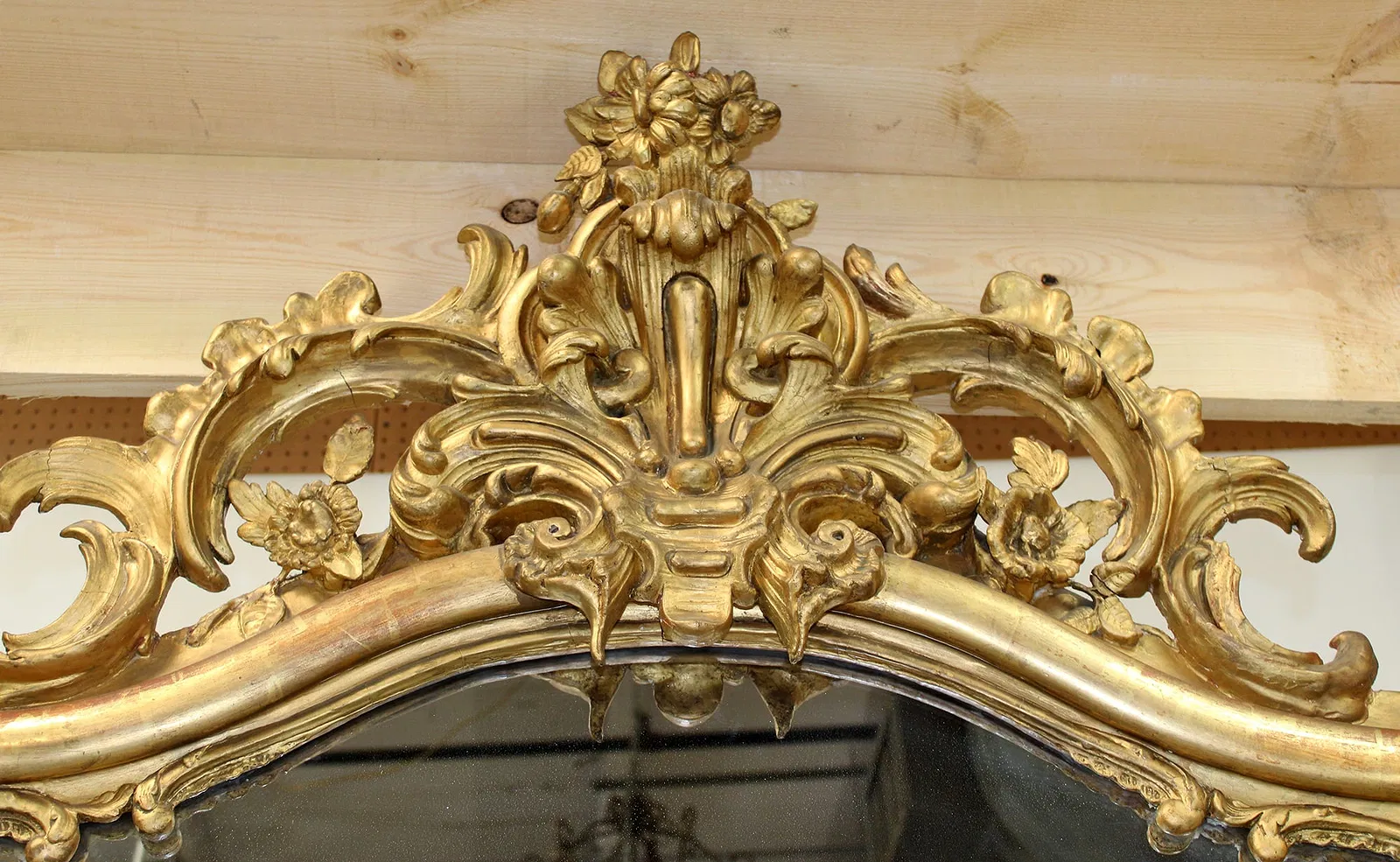
Here we have a striking Rococo Revival giltwood wall mirror — the sort of object that can make an otherwise sensible room suddenly feel theatrical, aristocratic, and just a bit flirtatious. Its tall proportions, pierced crest, and swirling foliage announce a love affair with the 18th century, though this example is firmly rooted in the revival spirit of circa 1850–1880. That distinction matters. The Rococo style was revived with enormous enthusiasm in the 19th century for grand interiors, particularly in the Italian taste. This mirror borrows the language beautifully: animated C-scrolls, floral sprays, asymmetrical energy, and a crest that rises like a plume. It was made to dazzle, and it still does. The materials tell the story well. The frame is carved wood with gesso and gilding laid over a red bole ground, portions of which now show through. That warm underlayer — visible at the edges and high points — along with rubbed gilding, minor gesso losses, and small shrinkage cracks, is exactly the kind of visual evidence one expects from a mid- to late-19th-century example. The mirror plate shows spotting and slight waviness consistent with age, though further examination would be needed to confirm full originality. Condition is honest rather than pristine: visible wear, small losses, and age-related surface irregularities are present, but they support rather than detract from its credibility. Comparable auction results for similar Italian Rococo Revival mirrors place it comfortably within a market range of $1,500 to $3,500. Not an 18th-century Rococo survivor, but a confident and decorative 19th-century revival piece — more opera than whisper.
Used for this report's TTS and avatar presentation.
Item Report
Rococo Revival Giltwood Wall Mirror
洛可可复兴风格鎏金木雕壁镜
Merge Reports: Yes (reconciled). Approval remains manual.
Attribution of Italian origin is stylistic and not supported by visible labels or construction details; confirmation would require inspection of the reverse and joinery.
Style: Rococo Revival
Origin: Probably Italy
Materials: carved wood, gesso, gilt finish over red bole, mirror plate
Age: circa 1850-1880
Condition: Good (visible gilding wear, minor losses, age-related cracking and mirror spotting; not professionally condition-reported)
Value: Auction estimate: $1,500-$3,500 USD
Peer-Reviewed Market Values
- Dating Range
- Pending structured dating
- Auction Liquidation
- Pending structured market values
- Fair Market Value
- Pending structured market values
- Replacement Value
- Pending structured market values
- Comparables Used
- No saved comparables yet
- Research Confidence
- Not Run
Peer review completed, but this run did not return structured market value ranges.
Maker's Marks / Writing: No maker's mark, inscription, or label visible in the provided images.
Date: 2026-03-24 01:40:49.540610
Description:
A large vertically oriented carved and giltwood wall mirror with exuberant Rococo Revival C-scrolls, floral sprays, and a pierced crest. The frame shows exposed red bole beneath worn gilding, age-related surface rubbing, minor gesso losses, and shrinkage cracks in the wood. The mirror plate displays spotting and slight waviness consistent with age. The carving appears hand-finished, yet the overall decorative regularity and composition are characteristic of a 19th-century Rococo Revival piece rather than an 18th-century Rococo period example. 一件大型竖向洛可可复兴风格鎏金木雕壁镜,饰有夸张的C形卷草、花卉装饰及镂空顶部。镜框鎏金层磨损处可见红色底土,伴有与年代相符的表面磨损、灰泥小缺失及木材收缩裂纹。镜面可见老化斑点与轻微波纹。整体雕刻为手工修饰,但构图与装饰的规整性更符合19世纪洛可可复兴风格,而非18世纪原始洛可可时期作品。
Curator Questions
Curated by Jade
Assessment:
This appears to be a substantial 19th-century Rococo Revival giltwood mirror of decorative quality, most likely Italian in taste and manufacture, though a specific workshop attribution cannot be confirmed from the available views. The high pierced crest, animated C-scrolls, and floral ornament faithfully echo the 18th-century Rococo vocabulary, interpreted through the lens of 19th-century revival design. The exposed red bole beneath the gilding, along with rubbed high points, small gesso losses, and visible shrinkage cracks, supports a 19th-century date. The mirror plate shows spotting and mild waviness consistent with age, though it cannot be definitively stated that all glass components are original without further physical examination. Rococo mirrors were widely produced in the 19th century for grand interiors, and this example fits comfortably within that tradition. The carving shows hand-finishing, yet the overall symmetry and decorative confidence align with revival production rather than an 18th-century period piece. Comparable auction examples from major houses support both the dating and the stated market range. Overall, the evidence favors a genuine mid- to late-19th-century Rococo Revival mirror rather than a modern reproduction, while stopping short of claiming 18th-century origin. 此镜应为19世纪洛可可复兴风格鎏金木雕壁镜,风格与工艺倾向意大利传统,但无法仅凭现有图像确认具体工坊。高耸镂空顶部、动感C形卷草与花卉装饰忠实再现18世纪洛可可语言,并以19世纪复兴风格加以诠释。 鎏金层下显露的红色底土、边缘磨损、灰泥小缺失及木材收缩裂纹均支持19世纪制作年代。镜面可见老化斑点与轻微波纹,但在未进行实物检测前,无法完全确认镜片是否全部原配。 洛可可风格壁镜在19世纪被广泛制作以装饰华丽室内空间,本例正属此类传统。整体雕刻虽为手工修饰,但构图的规整与装饰气质更符合复兴时期作品,而非18世纪原作。综合市场拍卖案例与风格特征判断,更倾向为19世纪中后期真品,而非现代复制品。
Individual Images:
- detail of crest carving; side detail of frame; full frontal view; upper section view; lower corner carving detail; visible gilding wear and exposed red bole; mirror plate spotting and waviness
Provenance:
No documentary provenance provided.
Condition:
Good (visible gilding wear, minor losses, age-related cracking and mirror spotting; not professionally condition-reported)
Identification Score: 95%
The form, pierced crest, carved C-scrolls, floral ornament, and giltwood construction clearly identify the object as a Rococo Revival wall mirror. The stylistic and material evidence is consistent across multiple views. 其造型比例、镂空顶部、C形卷草与花卉雕刻及鎏金木质结构均清晰指向洛可可复兴风格壁镜,多角度图像所见风格与材质特征一致。
Authenticity Score: 75%
Visible red bole beneath worn gilding, age-consistent surface rubbing, minor gesso losses, shrinkage cracks, and an aged mirror plate support a 19th-century origin. The revival character and decorative regularity argue against an 18th-century attribution. While photographs support period authenticity, confirmation of origin, gilding technique, and mirror plate originality would require physical inspection. 鎏金磨损处显露红色底土、与年代相符的表面磨损、灰泥小缺失、木材收缩裂纹及老化镜面均支持其为19世纪作品。其复兴风格特征与装饰规整度不支持18世纪原作归属。尽管图像显示具备时代特征,仍需实物检测以进一步确认产地、鎏金工艺及镜片是否原配。
Image Memory Note
Assessment based solely on provided images; reverse construction and backing not visible. 本评估仅基于所提供图像;未见背面结构与镜背细节。
Keywords
Rococo Revival mirror, giltwood wall mirror, carved gilt frame, pierced crest, C-scrolls, floral carving, 19th century, Italian taste 洛可可复兴风格壁镜, 鎏金木雕镜框, 镂空顶部, C形卷草, 花卉雕刻, 19世纪, 意大利风格
Peer Review Summary
Peer Review
Key Visible Evidence
The subject item is clearly a large, vertically oriented giltwood wall mirror, as depicted in Image 3 and Image 5. The frame exhibits characteristic Rococo Revival ornamentation, including prominent C-scrolls, floral sprays, and a pierced crest, visible in close-up views (Image 1, Image 4, Image 7). The materials appear to be carved wood with gesso and a gilt finish. Significant wear to the gilding is evident, exposing a red bole layer beneath, particularly visible along the frame's edges and raised elements (Image 2, Image 6, Image 7). The mirror plate shows signs of age, including spotting and waviness (Image 3, Image 6). Minor losses to the gesso and carving, along with shrinkage cracks in the wood, are also visible (Image 2, Image 6). No maker's marks, inscriptions, or labels are discernible in any of the provided images.
Market and Source Support
The report's identification of the mirror as 'Italian Rococo Revival Giltwood Wall Mirror' is strongly supported by grounded sources. Numerous auction comparables from reputable houses (Doyle, LiveAuctioneers, Christie's, Bonhams, Sotheby's) feature mirrors with highly similar stylistic elements, materials, and dating (late 19th to early 20th century). The dating of 'circa 1850-1880' for a Rococo Revival piece is consistent with the period commonly assigned to such items in the decorative arts market. The report's auction value estimate of $1,500-$3,500 for a 19th-century piece is well-aligned with the realized prices of the identified comparables, which range from approximately $1,250 to $2,560 USD, indicating a reasonable market positioning.
Needs Verification
While the style is consistent with Italian Rococo Revival, the specific 'Italian' origin lacks direct visible evidence (e.g., a label or construction details unique to Italian workshops). Further verification would require detailed examination of joinery and construction techniques on the reverse of the frame, which are not visible in the provided images. The report mentions 'water gilding or gilt finish over red bole'; while red bole is visible, confirming water gilding versus oil gilding or a later gilt application would necessitate specialized examination (e.g., magnification, chemical analysis) beyond photographic assessment. The originality of the mirror plate is noted as potentially not original throughout; a UV light examination of the mirror and its backing could provide more definitive information regarding replacements or repairs. The specific wood species used for the carving is not identified, which could offer additional insights into its origin or period.
Audit Conclusion
The report accurately identifies the subject item as a large giltwood wall mirror in the Rococo Revival style. The visual evidence strongly supports the dating to the 19th century, distinguishing it from 18th-century period Rococo examples, based on the decorative execution, visible wear patterns, and exposed red bole. The condition assessment is fair and consistent with the visible evidence. The value estimate is well-grounded by comparable auction results for similar Italian Rococo Revival mirrors of the stated period. While the overall assessment is sound, a definitive confirmation of the 'Italian' origin, the precise gilding technique, and the originality of the mirror plate would benefit from further physical inspection and specialized analysis.
Comparables (Similar Items)
No archived comparables matched this report yet.
Share: