Premium upgrade: Jade delivers your appraisal as a guided podium narration with synced visuals and voiceover.
Output is a narrated, animated slideshow with video intro and outro, sandwiching the autoplay voiceover sequence in actual video.
Chinese Ancestor Portrait of a Noblewoman中国贵妇祖先画像
LANGUAGE UNLOCK
Glossary Roundup
Original Presentation Script
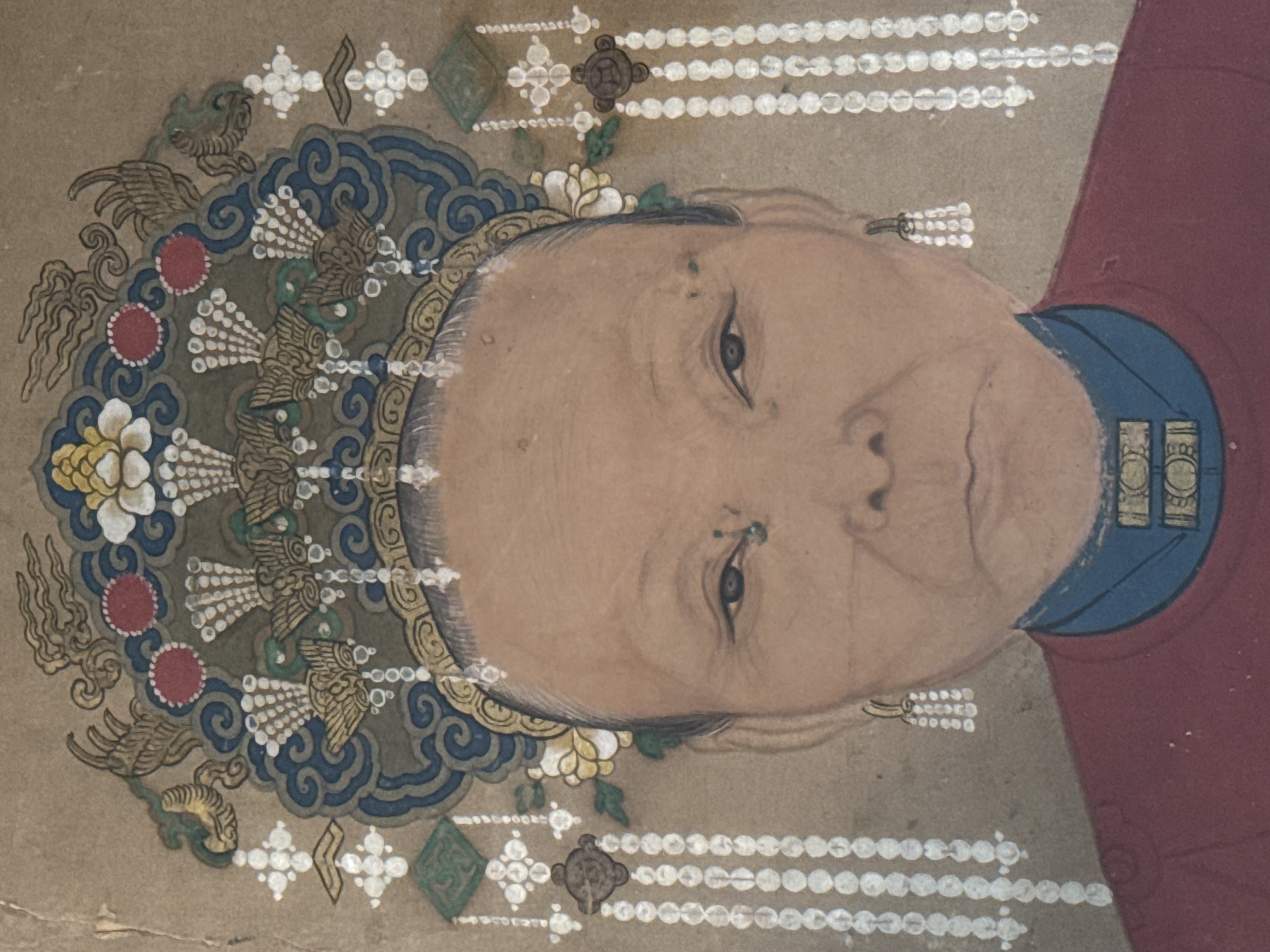
Hello, collectors! Today we're looking at a captivating piece of history: a Chinese Ancestor Portrait of a Noblewoman. These portraits were traditionally commissioned to honor deceased family members and were used in veneration rituals. This particular image gives us a striking close-up of the subject's face and her incredibly elaborate headdress.
Based on the style of the headdress, the formal attire, and the painting techniques, this piece likely dates to the late 19th or early 20th century, bridging the late Qing Dynasty and the early Republic Period. The artist has paid meticulous attention to the details of the pearls, jewels, and metalwork adorning her head, which contrasts beautifully with the realistic, almost austere depiction of her aged face.
The medium appears to be ink and color on paper or perhaps silk. We can see some signs of aging and surface wear, which is consistent with a piece of this vintage. It's important to note that we are only seeing a cropped section here; ancestor portraits are typically full-length, showing the subject seated in a formal chair.
While the visible evidence points towards an authentic period piece, the limited view keeps our authenticity score cautiously optimistic at 75%. If this is indeed an authentic late Qing or early Republic period fragment, a conservative auction estimate would be in the $300 to $800 range. It's a wonderful glimpse into the past and the enduring tradition of honoring one's ancestors. A truly fascinating face to study!
Used for this report's TTS and avatar presentation.
Age:Late 19th to early 20th century (Qing Dynasty to Republic Period)
Condition:Fair to Good (visible aging, some surface wear, appears to be a fragment or cropped image)
Value:Authentic Period: $300 - $800; Later Reproduction/Copy: $50 - $150
Peer-Reviewed Market Values
Dating Range
Pending structured dating
Auction Liquidation
Pending structured market values
Fair Market Value
Pending structured market values
Replacement Value
Pending structured market values
Comparables Used
No saved comparables yet
Research Confidence
Insufficient Data
Peer review completed, but this run did not return structured market value ranges.
Maker's Marks / Writing:None visible in the provided image.
Date:2026-08-25 12:55:29.499117
Description:
A detailed portrait of an elderly Chinese woman, likely an ancestor portrait, wearing an elaborate headdress adorned with pearls, jewels, and intricate metalwork. She is depicted with a serious expression, wearing a red garment with a blue collar. The painting style is characteristic of traditional Chinese portraiture, focusing on facial details and formal attire.
一幅细致的中国老年妇女肖像,很可能是祖先画像,戴着装饰有珍珠、珠宝和复杂金属工艺的华丽头饰。她表情严肃,穿着带有蓝色领子的红色衣服。绘画风格具有传统中国肖像画的特征,注重面部细节和正式着装。
Curator Questions
Curated by Jade
Assessment:
This appears to be a fragment or a close-up section of a larger Chinese ancestor portrait. The level of detail in the headdress and the facial features suggests it was painted by a skilled artisan. The paper/silk shows signs of aging, consistent with a late 19th or early 20th-century origin. However, without seeing the full context of the painting, its mounting, and the overall condition, a definitive assessment is challenging.
这似乎是一幅较大的中国祖先画像的碎片或特写部分。头饰和面部特征的细节水平表明它是由熟练的工匠绘制的。纸张/丝绸显示出老化迹象,与19世纪末或20世纪初的起源一致。然而,如果没有看到画作的完整背景、装裱和整体状况,很难做出明确的评估。
Individual Images:
detail of ancestor portrait face and headdress
Provenance:
None provided.
Condition:
Fair to Good (visible aging, some surface wear, appears to be a fragment or cropped image)
Identification Score: 90%
The subject matter, style, and attire strongly identify this as a Chinese ancestor portrait.
主题、风格和着装强烈表明这是一幅中国祖先画像。
Authenticity Score: 75%
The visible aging of the material and the traditional painting techniques suggest it is an authentic piece from the estimated period. However, the limited view prevents a higher score, as reproductions and later copies do exist.
材料的可见老化和传统的绘画技巧表明它是估计时期的真品。然而,有限的视野阻碍了更高的分数,因为确实存在复制品和后来的仿制品。
Image Memory Note
None
None
Keywords
Chinese, Ancestor Portrait, Qing Dynasty, Noblewoman, Headdress, Painting, Asian Art
中国, 祖先画像, 清朝, 贵妇, 头饰, 绘画, 亚洲艺术
The report was edited after initial Artmink draft. Original AI draft preserved in Artmink audit history.
Peer Review Summary
Dating Range
Late 19th to early 20th century (Qing Dynasty to Republic Period)
Fair Market Value
Pending structured market values
Replacement Value
Pending structured market values
Archived Matches
No archive matches yet
Research Confidence
Insufficient Data
Peer Review
Key Visible Evidence
Image 1 displays a tightly cropped portrait of an elderly woman wearing a traditional Chinese phoenix coronet (fengguan) and a red robe with a blue collar. The meticulous, flat rendering of the facial features and the intricate detailing of the headdress are characteristic of Chinese ancestor portraits. Visible creases and the brownish tone of the substrate suggest some age, though the tight crop obscures the full context and format of the piece.
Market and Source Support
Grounded sources confirm that ancestor portraits depicting women in red robes and elaborate phoenix coronets were standard commissions during the Qing Dynasty and into the Republic period to honor deceased family members. The specific headdress elements, including ruyi-shaped blue motifs (often representing kingfisher feathers) and pearl strands, align with established iconography for wives of officials or noblewomen.
Needs Verification
- Full view of the painting to determine if it is a physical fragment, a cropped photograph, or a smaller format portrait.
- Close-up of the substrate (paper vs. silk) and any mounting or framing to better assess age and authenticity.
- Examination of the reverse side for any inscriptions, labels, or signs of artificial aging.
Audit Conclusion
The report's identification of the image as a Chinese ancestor portrait is supported by visible stylistic evidence and standard iconography. The dating to the late 19th or early 20th century is plausible based on the visible aging and style, but remains unproven without a full view of the object and its construction.

Share: