Jade : Chinese Fine and Decorative Arts
Jade Presents

Original Presentation Script
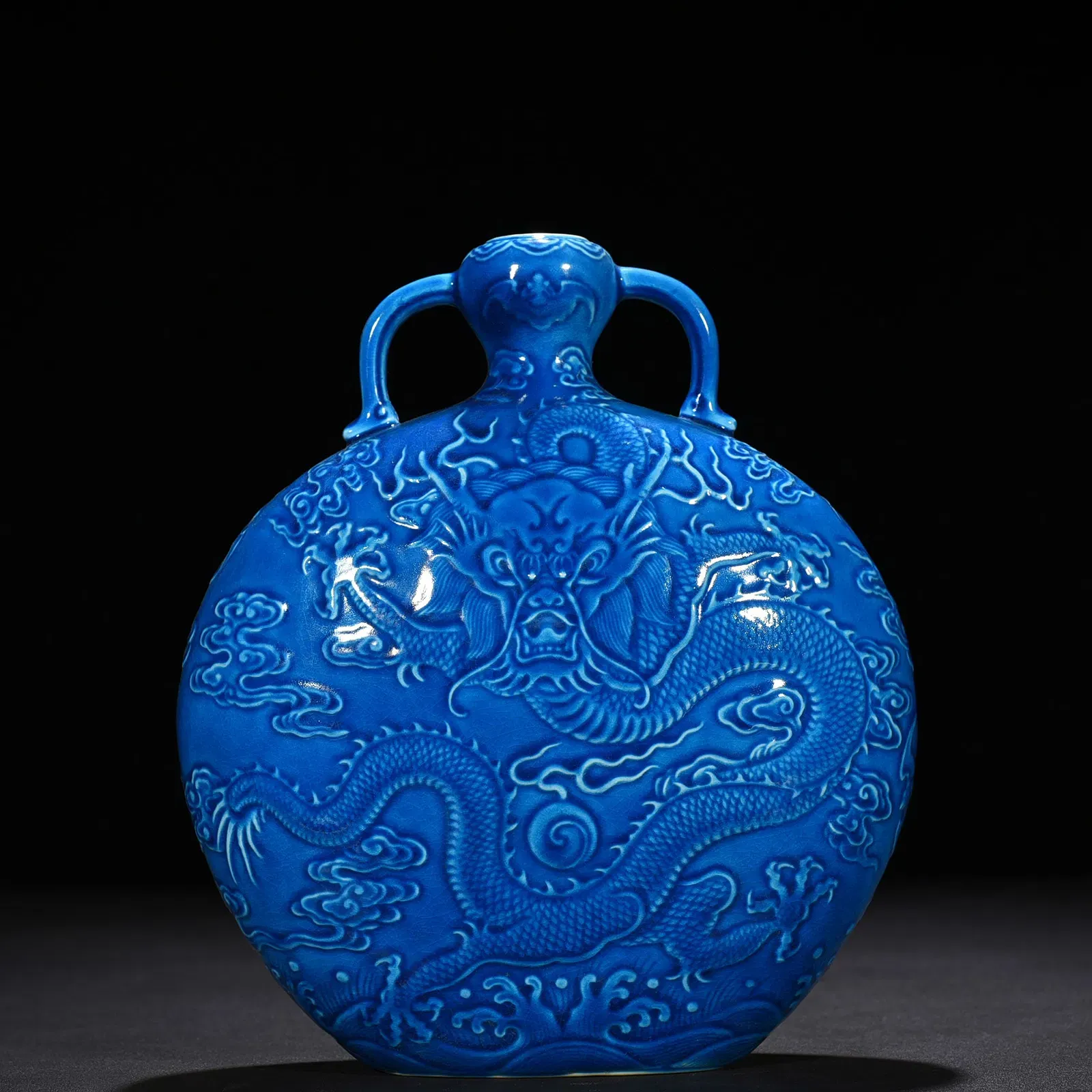
Here we have a Chinese Qing Style monochrome blue relief porcelain moon flask — a form that has long captivated collectors because it compresses sculpture, symbolism, and courtly design into one elegant vessel. The flattened body and twin handles echo earlier pilgrim-flask traditions, while the writhing dragon in clouds unmistakably channels imperial taste. The visual language points toward Qing dynasty inspiration, especially Qianlong-era decorative ambition, and the base even carries a six-character Qianlong seal mark. But marks are cheap talk in Chinese ceramics, and this one should be read as an homage, not proof. A word about copies.. this category is awash in reproductions, and dragon-marked monochrome wares are particularly vulnerable. Materially, it appears to be porcelain with molded relief under a saturated turquoise-blue glaze. The decoration is bold and handsome, but also a little too crisp, too even, too cosmetically perfect. The glaze has a fresh, glossy confidence that feels modern rather than time-softened. Condition appears excellent from the photographs — no obvious chips or cracks visible — though that very cleanliness is part of the skepticism. There is little honest wear around the foot or handles, and the recessed base and mark look highly controlled. So, my conclusion: an attractive modern Qing-style reproduction, not a period imperial flask. I’d place the authenticity score around 18%. Auction estimate as seen: about USD 300-900. If it were genuinely Qing imperial, we’d be in a very different neighborhood entirely — roughly USD 15,000-40,000 or more. A handsome dragon, yes — but one wearing a modern costume.
Used for this report's TTS and avatar presentation.
Item Report
Chinese Qing Style Monochrome Blue Relief Porcelain Moon Flask
中国清式单色蓝釉浮雕龙纹瓷抱月瓶
By: Unknown
Style: Chinese Qing Style porcelain, molded monochrome relief ware
Origin: China
Materials: Porcelain with monochrome blue glaze, molded and relief decoration, underglaze blue apocryphal seal mark
Age: Late 20th to early 21st century
Condition: Excellent (no obvious chips or cracks visible, but likely modern piece; condition based only on photos)
Value: If authentic Qing imperial example: USD 15,000-40,000 at auction; as a later reproduction/decorative studio piece: USD 300-900 at auction
Peer-Reviewed Market Values
- Dating Range
- Pending structured dating
- Auction Liquidation
- Pending structured market values
- Fair Market Value
- Pending structured market values
- Replacement Value
- Pending structured market values
- Comparables Used
- No saved comparables yet
- Research Confidence
- Not Run
Peer review completed, but this run did not return structured market value ranges.
Maker's Marks / Writing: Apocryphal six-character seal mark reading 大清乾隆年製 ('Made in the Great Qing, Qianlong period').
Date: 2026-03-16 04:02:55.033334
Description:
A flattened moon flask with twin loop handles and molded high-relief dragon among clouds decoration under a vivid monochrome turquoise-blue glaze. The base bears an apocryphal six-character seal mark in underglaze blue within the recessed foot. The modeling is crisp and decorative, but the glossy surface, even coloration, and highly controlled mark suggest a later decorative reproduction rather than a Qing period imperial piece. 一件扁圆抱月瓶,双耳环形柄,器身通体模印高浮雕云龙纹,施鲜艳的单色松石蓝釉。底部凹足内见青花六字篆书款。其造型清晰华丽,但表面光泽较新、发色过于均匀,底款亦显得过于工整可控,更像后期装饰性仿作,而非清代官窑时期器物。
Curator Questions
Curated by Jade
Assessment:
This appears to be a Chinese Qing Style porcelain moon flask made as a later decorative or studio reproduction, most likely late 20th to early 21st century. The form imitates earlier flattened pilgrim or moon flask types, and the dragon-and-cloud relief draws on imperial Qing visual language. However, the fakery check raises clear concerns: the glaze is extremely fresh and uniform, the relief is mechanically crisp rather than softly worn by age, and the underside mark looks neatly contrived in a way often seen on modern tribute wares. The recessed foot also appears very clean and regular, with little of the nuanced firing wear one expects from a genuinely old object. A word about copies.. Chinese ceramics are one of the most heavily reproduced categories in the market, especially Qing-inspired monochrome and dragon wares with reign marks; modern revival pieces vastly outnumber true period examples. The base mark appears to read 大清乾隆年製, translated as 'Made in the Great Qing, Qianlong period,' but on this vessel it should be treated as apocryphal rather than evidence of 18th-century date. Visually attractive, yes; safely catalogued as a modern Qing-style reproduction, also yes. {chavatar_catchphrase} 此器应为一件中国清式瓷抱月瓶,属于后期装饰性或工作室性质的仿制品,年代大致在20世纪晚期至21世纪初。器形模仿早期扁圆抱月瓶或扁壶样式,云龙浮雕也借用了清代宫廷器物的视觉语言。然而经“仿伪核查”后,疑点相当明显:釉面过于新亮且发色均匀,浮雕线条显得过分利落机械,缺少岁月磨蚀后的自然钝化;底部款识亦工整得近乎刻意,这类情形常见于现代仿古陈设瓷。凹足内外也过于洁净规整,缺乏真正老瓷应有的火石红、磨损与窑烧痕迹层次。A word about copies.. 中国瓷器是市场上仿制最泛滥的门类之一,尤其是仿清单色釉、龙纹器及带年款器,现代仿古品远多于真正到代之物。底款看似为“大清乾隆年製”,可译作“清朝乾隆年间制造”,但在本器上应视为寄托款,不可据此断为十八世纪真品。观赏性不错,但审慎结论应定为现代清式仿制品。{chavatar_catchphrase}
Individual Images:
- whole moon flask front
- upper half moon flask
- detail of dragon relief
- lip of moon flask
- side view moon flask
- whole moon flask front
- detail of dragon relief
- base of moon flask mark
Provenance:
No provenance documentation shown in the images.
Condition:
Excellent (no obvious chips or cracks visible, but likely modern piece; condition based only on photos)
Identification Score: 94%
The form, molded dragon decoration, monochrome glaze, twin handles, and recessed marked base clearly indicate a Chinese-style porcelain moon flask in Qing taste, even though exact dating and status as period vs later copy remain separate questions. 器形、模印龙纹、单色釉、双耳以及带款凹足等特征都清楚表明这是一件中国风格的瓷质抱月瓶,具有明显清代审美取向;只是其具体年代及是否到代需与器物类别识别分开判断。
Authenticity Score: 18%
Authenticity is low because the glaze appears overly glossy and even, the relief is unusually sharp and consistent, the base mark seems apocryphal, and there is little visible age wear or firing irregularity. Following a strict reproduction-first standard, this is best treated as a modern reproduction unless proven otherwise by hands-on examination and testing. 真品可能性较低,原因在于釉面过分光亮均匀,浮雕线条过于锋利一致,底款应为寄托款,且整体几乎看不到自然老化磨损或古瓷常见的烧造不规则痕迹。按照“先视为仿品,除非有充分证据证明其为真”的严格标准,本器应归为现代仿制品,除非经上手检视与检测另有结论。
Image Memory Note
None None
Keywords
Chinese porcelain, Qing Style, moon flask, monochrome blue glaze, relief dragon, dragon vase, twin handles, apocryphal Qianlong mark, reproduction, China 中国瓷器, 清式, 抱月瓶, 单色蓝釉, 浮雕龙纹, 龙纹瓶, 双耳, 乾隆寄托款, 仿制品, 中国
Peer Review Summary
Peer Review
Key Visible Evidence
Images 1-7 consistently show a highly uniform and glossy monochrome blue glaze, lacking the subtle variations and depth often associated with genuine Qing dynasty glazes. The molded dragon and cloud relief (Images 1-3, 6-7) is exceptionally crisp and well-defined, suggesting modern manufacturing techniques rather than the softer wear or less precise molding sometimes seen in older pieces. Image 8, depicting the base, reveals a very clean and regular unglazed footrim with no discernible signs of age-related wear, kiln grit, or firing imperfections. The underglaze blue six-character seal mark, reading 大清乾隆年製 ('Made in the Great Qing, Qianlong period'), is applied with a high degree of neatness and control, further supporting the assessment of a later production.
Market and Source Support
General knowledge of Chinese ceramic production indicates that genuine Qing dynasty imperial monochrome wares, particularly from the Qianlong period, typically exhibit more nuanced glaze characteristics, including slight pooling, variations in thickness, and a less 'perfect' factory finish compared to the subject item. Footrims on authentic period pieces often show signs of age, handling wear, and specific firing characteristics (e.g., 'iron rust' spots, fine grit adhesion) that are absent here. The prevalence of well-executed modern reproductions of Qing-style moon flasks with apocryphal reign marks is a well-documented market phenomenon, making the report's cautious approach appropriate.
Needs Verification
While the visual evidence strongly supports the report's conclusion, a definitive determination of age and authenticity would benefit from a hands-on physical examination. This would allow for assessment of the porcelain body's weight, resonance, and specific firing characteristics; microscopic examination of the glaze surface for micro-crazing or wear patterns; and UV light testing to detect any potential repairs, overpainting, or alterations not visible in the provided images. Further analysis of the biscuit material composition could also provide additional dating evidence.
Audit Conclusion
The report's assessment of the moon flask as a modern, late 20th to early 21st-century reproduction in Qing style is well-grounded and robustly supported by the visible photographic evidence. The characteristics noted in the report —specifically the glaze quality, crispness of molding, pristine footrim, and neat apocryphal mark —are all consistent with contemporary decorative production rather than an 18th-century imperial piece. The report's skepticism regarding authenticity is fully justified.
Comparables (Similar Items)
No archived comparables matched this report yet.
Share: