Japanese Edo Period Iron and Lacquered Samurai Armor (Yoroi Gusoku)
LANGUAGE UNLOCK
Glossary Roundup
Original Presentation Script
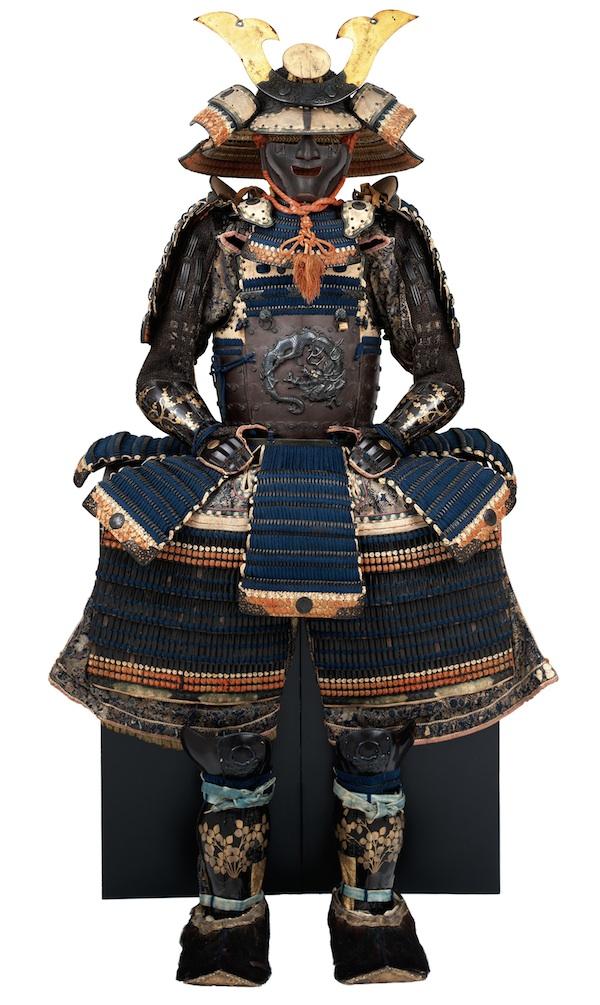
This commanding figure is a Japanese Edo Period Iron and Lacquered Samurai Armor — a full yoroi gusoku, the battlefield skin of a warrior elite. From the dramatic gilt kuwagata horns crowning the kabuto to the layered blue-laced lamellae at the thighs, it projects exactly the theatrical grandeur that made samurai armor as much psychological weapon as protection.
Stylistically we’re in the late Edo period, when armor had shifted from strictly practical battlefield gear to symbols of rank and lineage. The embossed dragon on the cuirass and the rich, patterned fabrics of the thigh and shin guards speak to display, ceremony, and status as much as combat readiness.
Technically, we see lacquered iron plates, leather, and dense silk odoshi lacing, all laboriously hand-assembled. The mix of russet iron, black lacquer, and indigo lacing is classic — sober, yet richly textured under light.
The textiles show softening and wear, the lacquer appears gently dulled rather than freshly sprayed, and the mask has that slightly uneven hand-worked character we expect from pre-industrial armor. That said, many such suits are "marriages" of old parts and later restorations; the leg and fabric elements, in particular, may have been refreshed.
Balancing those signals, I’d give authenticity a cautious 55%, leaning toward a composite suit with substantial Edo-period components. In today’s auction market, that places it around $25,000–$45,000 if largely original, and $6,000–$12,000 if more heavily reconstructed.
Either way, it remains an arresting ambassador of samurai culture — the sort of piece that turns any room into a daimyo’s audience hall.
Used for this report's TTS and avatar presentation.
Item Report
Japanese Edo Period Iron and Lacquered Samurai Armor (Yoroi Gusoku)
By:Unknown Japanese armorer
Style:Japanese Edo Period Samurai Armor
Origin:Japan
Materials:Lacquered iron plates, leather, silk lacing (odoshi), textile, animal hair, gilt metal crests
Age:Circa late 18th–early 19th century (late Edo period), with possible later assembly or replaced components
Condition:Good (overall complete and visually strong, but evident wear, age to textiles, and likely restorations/repairs)
Value:If largely authentic Edo-period components: US $25,000–$45,000 at auction. If predominantly 20th-century assembled/reproduction: US $6,000–$12,000.
Maker's Marks / Writing:No mei or inscriptions visible from the provided image.
Date:2025-12-13 01:11:38.965587
Description:
A full suit of Japanese samurai armor (yoroi gusoku) comprising kabuto helmet with large gilt kuwagata crests, russet-iron menpō mask with moustache, lamellar dō cuirass with embossed dragon, sode shoulder guards, kusazuri skirt, kote arm guards, haidate thigh protection and suneate shin guards. The plates are laced in dark blue silk with contrasting beige and orange accents, over black lacquered iron and leather components, with decorative printed fabric on the haidate and suneate.
Curator Questions
Curated by Jade
Assessment:
This is a visually impressive, fairly complete suit of Japanese samurai armor in late Edo-period style, with dark-blue lacing and bold gilt helmet crests. The overall design, proportions, and mix of components are consistent with 18th–19th century armor, though many extant suits were assembled from pieces of varying dates and occasionally restored. Surface details in the photo—such as the patinated iron, slightly dulled lacquer, and worn textile lower sections—suggest age and use rather than a purely modern decorative replica, but without close-ups of plates, rivets, interior construction, and lacing, it is prudent to assume some level of restoration or reconfiguration. A word about fakes.. Japanese armor is heavily copied for the décor market; many suits are composite or modern tourist pieces, so professional hands-on inspection is recommended before treating it as a fully original set.
Individual Images:
none
Provenance:
Not provided.
Condition:
Good (overall complete and visually strong, but evident wear, age to textiles, and likely restorations/repairs)
Identification Score: 88%
Form, components and lacing clearly match a Japanese yoroi gusoku samurai armor of Edo-period type; while individual school/armorer cannot be specified from the photo, the general category is secure.
Authenticity Score: 55%
The style, patina, and construction details visible are consistent with genuine Edo armor, but the market is full of reconstructed suits combining old and newer parts. Without close inspection of interior construction, lacquer craquelure, and textile weaves, I treat this as likely containing authentic components but possibly assembled and restored, hence a mid-range authenticity score.
Image Memory Note
None
None
Keywords
Japanese, Edo period, samurai armor, yoroi gusoku, kabuto, menpo, lacquered iron, Japan
The report was edited after initial Artmink draft. Original AI draft preserved in Artmink audit history.

Share: