Jade : Chinese Fine and Decorative Arts
Jade Presents

Original Presentation Script
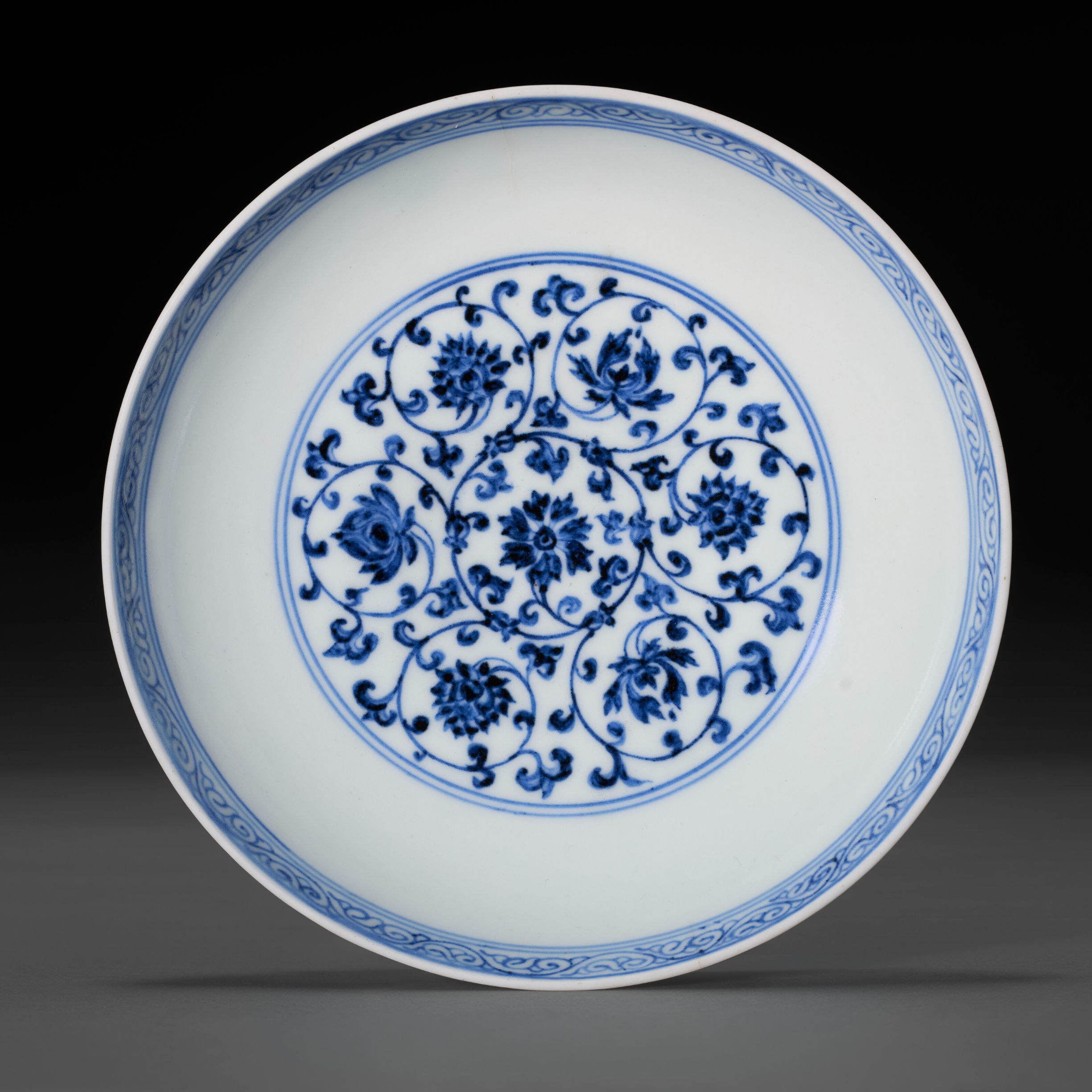
Here we have a Chinese Xuande Style Blue and White Porcelain Dish — a form beloved by collectors because it sits right at the crossroads of elegance, scholarship, and danger. Danger, because Xuande-marked blue and white is one of the most copied categories in all of Chinese ceramics. The dish borrows its visual language from early Ming court taste: crisp blue floral scrolls, a restrained cavetto, and that tempting six-character mark on the base, reading 'Da Ming Xuande Nian Zhi' — 'Made in the Xuande reign of the Great Ming.' That sounds thrilling. But thrilling and true are not always the same thing. The porcelain here looks well made, with a pleasant white body and competent underglaze cobalt decoration. Yet the painting feels more controlled than alive, the glaze and footrim more regular than one expects on a genuine 15th-century imperial dish. In other words, it looks like a respectable later homage, not an imperial survivor. Condition appears generally strong from the photos, with modest wear and some staining around the foot, but no obvious major chips or cracks visible. The old labels — including Peter Boode London and an Oriental Ceramic Society exhibition sticker dated 1954 — do add interest and confirm mid-20th-century circulation, though not Xuande authenticity. So: identification is high, authenticity is not. I’d place the authenticity score at 22%. Auction estimate as a later Xuande style piece: about $800 to $2,000. If it were genuinely Xuande period, we’d be in a dramatically different universe — roughly $80,000 to $250,000 or more. A beautiful lesson, in short, that the mark is the invitation, not the verdict.
Used for this report's TTS and avatar presentation.
Item Report
Chinese Xuande Style Blue and White Porcelain Dish
中国宣德式青花瓷盘
By: Unknown kiln or workshop
Style: Chinese blue and white porcelain, Xuande style
Origin: China
Materials: Porcelain with underglaze cobalt blue decoration
Age: Probably late Qing to Republic period, circa 1880-1930
Condition: Very Good (minor wear and staining to foot/base area, no major damage visible from provided images)
Value: Auction estimate: if authentic Ming Xuande period example, likely $80,000-$250,000+ depending on size, condition, and provenance; as a later Xuande style example, approximately $800-$2,000
Peer-Reviewed Market Values
- Dating Range
- Pending structured dating
- Auction Liquidation
- Pending structured market values
- Fair Market Value
- Pending structured market values
- Replacement Value
- Pending structured market values
- Comparables Used
- No saved comparables yet
- Research Confidence
- Not Run
Peer review completed, but this run did not return structured market value ranges.
Maker's Marks / Writing: Underglaze blue six-character mark: 大明宣德年製 / 大明宣德年制 ('Made in the Xuande reign of the Great Ming'). Also labels reading 'Peter Boode London', 'Oriental Ceramic Soc. 1954 Exhibn. 60', and 'H.H.G. C4' or similar inventory notation.
Date: 2026-03-25 11:34:08.572192
Description:
Shallow blue and white porcelain dish with central scrolling floral medallion, exterior floral scroll decoration, and a six-character Xuande mark in underglaze blue on the base. The drawing is neat and decorative, with a fairly even white body and clean foot, suggesting a later apocryphal-mark example rather than a Ming-period imperial piece. 浅腹青花瓷盘,盘心绘缠枝花卉团花纹,外壁饰缠枝花卉纹,底部以青花书双方框六字宣德款。纹饰工整而装饰性较强,胎釉较匀净,圈足修整规整,显示其更可能是后期仿款器,而非明代宣德御窑本朝器。
Curator Questions
Curated by Jade
Assessment:
This appears to be a Chinese blue and white dish made in the style of Xuande porcelain, but almost certainly not of the Xuande period itself. The six-character mark reads 'Da Ming Xuande Nian Zhi' (Made in the Xuande reign of the Great Ming), yet the mark, porcelain body, and overall finish do not persuade as early 15th century imperial work. The shape is competent, the cobalt pleasant, and the decorative scheme attractive, but the surfaces look comparatively crisp and controlled, with little of the spontaneous energy, glaze character, and period foot treatment expected of true Xuande wares. The old dealer and exhibition labels do indicate the piece circulated in the mid-20th century, which supports age as an older collectible, though not necessarily Ming authenticity. A word about copies.. blue and white Chinese porcelain is one of the most heavily copied categories in the entire antiques trade, and Xuande-marked wares are especially prone to later revival pieces, workshop copies, and deliberate forgeries. Fakery check: the apocryphal reign mark, the relatively clean and even paste, and the lack of unmistakable early imperial kiln features all point toward a later decorative or collector-market example rather than a period imperial object. 这件器物应为中国青花瓷盘,属宣德风格,但几乎可以肯定并非宣德本朝之物。底部六字款为“大明宣德年制”,然而从款识书写、胎体、釉面与整体气息来看,均不足以支持其为十五世纪早期御窑真品。其器形端正,青花发色悦目,纹饰布局亦颇具观赏性,但表面观感较为匀整、受控,缺少真正宣德官窑常见的自然笔意、釉质变化与典型圈足特征。底部旧古董商与展览标签说明该器至少在二十世纪中期已进入收藏流通,这可支持其为较早的收藏品,但并不能证明其为明代真器。A word about copies.. 青花瓷是中国古陶瓷中仿制最泛滥的门类之一,而署宣德款者尤多后仿、寄托款与蓄意伪作。仿伪检视:此器的寄托年款、较洁净匀一的胎釉,以及缺乏早期御窑关键时代特征,均更支持其为后期装饰性或收藏市场取向的仿宣德器。
Individual Images:
- front dish
- underside dish with mark
- side view of dish
- detail of base mark
- detail of side decoration
- detail of central floral medallion
Provenance:
Visible old labels suggest prior handling by Peter Boode, London, and exhibition or cataloging by the Oriental Ceramic Society in 1954, lot/object 60. These labels are useful but do not alone establish Ming-period authenticity.
Condition:
Very Good (minor wear and staining to foot/base area, no major damage visible from provided images)
Identification Score: 94%
The form, decoration, underglaze-blue technique, and base mark clearly identify it as a Chinese blue and white porcelain dish made in the Xuande taste. 根据器形、纹饰、青花釉下彩工艺及底部款识,可较明确判断其为一件中国青花瓷盘,属于宣德风格作品。
Authenticity Score: 22%
The Xuande mark is almost certainly apocryphal. The foot, paste, glaze surface, and painted style do not convincingly match a genuine Ming Xuande imperial dish. Old collection and dealer labels suggest age and circulation, but not Xuande-period authenticity; they are not proof against a later copy. 此“宣德”款几乎可以确定为寄托款。圈足、胎质、釉面与绘画风格均不足以令人信服地对应真正明宣德御窑瓷盘。旧藏家与古董商标签可说明其有一定流传历史,但并不能证明其为宣德本朝真品,也不足以排除后仿。
Image Memory Note
None None
Keywords
Chinese porcelain, blue and white, Xuande style, floral scroll dish, underglaze blue, apocryphal mark, Ming style, China 中国瓷器, 青花, 宣德式, 缠枝花卉盘, 釉下青花, 寄托款, 明代风格, 中国
Peer Review Summary
Peer Review
Key Visible Evidence
The subject dish (Image 1, 3) displays a classic Xuande-style floral scroll motif, executed in underglaze blue. The blue tone is notably consistent and lacks the characteristic 'heaping and piling' effect, which is a hallmark of genuine early Ming cobalt blue, particularly from the Xuande period (Image 5, 6). The porcelain body appears uniformly white and fine-grained, and the footrim (Image 2, 4) is cleanly finished, without the typical 'iron rust' spots or slightly irregular potting expected of early 15th-century imperial wares. The base features a six-character underglaze blue mark, clearly legible as 大明宣德年製 (Da Ming Xuande Nian Zhi) within a double circle (Image 2, 4). The script is regular (Kaishu), neatly drawn. Three labels are visible on the base (Image 2, 4): 'H.H.G. C4', 'ORIENTAL CERAMIC SOC. 1954 EXHIB'N. 60', and 'PETER BOODE CHINESE ANTIQUES LONDON'. These labels confirm mid-20th century circulation and provenance through a notable dealer and exhibition, supporting the item's age as an older collectible.
Market and Source Support
The report's assessment that the Xuande mark is apocryphal and the dish dates to the late Qing to Republic period (circa 1880-1930) is well-grounded in the established connoisseurship of Chinese blue and white porcelain. Xuande marks are among the most frequently copied, and the visual characteristics observed (evenness of blue, refined paste, clean footrim, controlled painting style) are consistent with later revival pieces rather than early Ming imperial production. The comparables identified, all described as 'Xuande style' or 'apocryphal Xuande mark' dishes from the late 19th/early 20th century, consistently achieve prices in the $900-$1,300 range. This strongly supports the report's auction estimate of $800-$2,000 for a later example and the significant price differential for a genuine Ming piece.
Needs Verification
While the visual evidence strongly suggests a later date, a more definitive determination of the exact manufacturing period (e.g., late Qing vs. early Republic) could benefit from macro photography of the glaze surface to examine for specific firing characteristics, and potentially UV light examination to rule out any subtle restorations or alterations not visible in the provided images. The precise meaning or context of the 'H.H.G. C4' label is not immediately clear and could be further investigated if a full provenance chain is desired beyond the Peter Boode and OCS labels.
Audit Conclusion
The audit confirms the report's primary conclusions. The visible evidence, particularly the characteristics of the underglaze blue, porcelain body, footrim, and painting style, strongly supports the assessment that the dish is a later 'Xuande style' piece with an apocryphal mark, rather than a genuine Ming imperial example. The legible six-character mark '大明宣德年製' is correctly transcribed. The presence of mid-20th century dealer and exhibition labels confirms its history as an older collectible, but not its Ming authenticity. The valuation range for a later piece is well-supported by market comparables. The report demonstrates a sound understanding of Chinese porcelain dating and authenticity challenges.
Comparables (Similar Items)
No archived comparables matched this report yet.
Share: