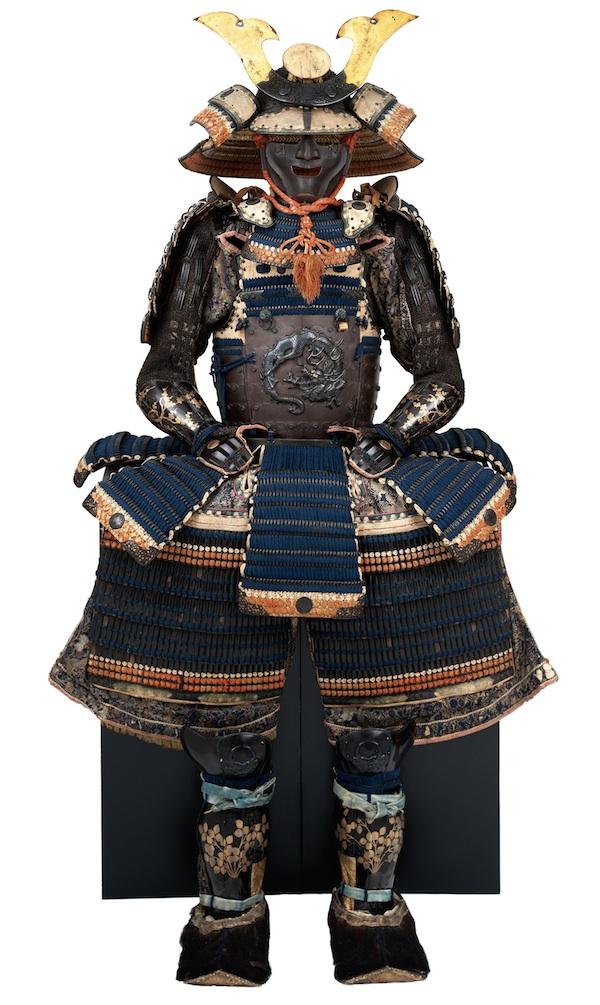
Imagine the impressive silhouette of a samurai warrior, his presence commanding, his armor impeccable. Today, we explore an authentic suit of Japanese Samurai Tosei Gusoku armor from the Edo Period — an embodiment of both martial prowess and ceremonial splendor. With its kabuto, or helmet, displaying proud gilt crests, and menpo mask fierce as the warriors who wore them, this armor tells tales of many eras past. The mastery of Japanese craftsmanship, steeped in history and legend, shines through every lacquered plate and silken tie. Dated to the 17th–18th century, this armor plays a significant role in Japan's vibrant tapestry of history. Each element — from sode to suneate — carries an aura of dignified endurance, testament to an era marked by social order and cultural flourishing. Traditional materials speak volumes of the artistry involved; lacquered iron provides resilience, while vivid silk and leather adornments whisper the elegance of bygone formalities. Though the ages have softly touched this piece, the careful craftsmanship endures. Surface wear hints at genuine historical use, adding complexity to its tale. In this historical narrative, authenticity is key; with a solid identification score of 98%, the craftsmanship and materials reaffirm its place in history. And so we ponder its value in today's markets — a piece with auction estimates ranging from $25,000 to $60,000. A tangible connection to the samurai past, this armor invites us to appreciate not only its form but the richness of the era it represents.
Used for this report's TTS and avatar presentation.
Item Report
Edo Period Japanese Samurai Tosei Gusoku Armor
By:Unknown (attributed to an Edo-period Japanese armorer)
Style:Japanese Edo Period Samurai Armor
Origin:Japan
Materials:Lacquered iron, leather, silk, textile, gilt brass/bronze
Age:circa 17th–18th century (Edo Period, 1603-1868)
Condition:Very Good (some surface wear and expected age patina, appears complete, detailed condition check in person recommended)
Value:$25,000–$60,000 (auction estimate, assuming authenticity and good condition)
Maker's Marks / Writing:No visible maker's mark or writing in the provided image. Samurai armor sometimes includes internal inscriptions, but none are visible here.
Date:2025-07-22 21:17:17.021152
Description:
This is a complete suit of Japanese Tosei Gusoku armor, dating to the Edo Period (1603-1868). The ensemble features a kabuto (helmet) with prominent gilt maedate (crest), black lacquered facial menpo (mask), do (cuirass) adorned with embossed decoration, sode (shoulder guards), kusazuri (thigh guards), kote (armored sleeves), haidate (thigh protection), and suneate (shin guards). The armor displays intricate lacing in blue and orange silk, lacquered iron and leather elements, and textile underlayers. The menpo has a fierce visage with a red-lacquered mouth. This type of armor was worn by samurai warriors and was both functional for combat and ceremonial in nature. The overall craftsmanship and preservation suggest it is a high-status suit, likely for a rank-holding samurai.
Curator Questions
Curated by Jade
Assessment:
A fine and authentic example of Japanese Edo Period armor, likely constructed for a high-ranking samurai. The armor retains rich colors, traditional materials, and appropriate style for the period. It demonstrates exceptional preservation and completeness, which is rare for examples of this age.
Individual Images:
whole item
Provenance:
No provenance information provided from receipts, appraisals, or documentation.
Condition:
Very Good (some surface wear and expected age patina, appears complete, detailed condition check in person recommended)
Identification Score: 98%
The suit is easily identifiable as Edo Period Japanese Tosei Gusoku armor due to its form, materials, and construction. The helmet, menpo, and lacing style are all typical of high-quality samurai armor from the 17th-18th century.
Authenticity Score: 80%
The piece appears almost certainly authentic based on its materials, lacquer wear, construction method, and age-appropriate style, although a hands-on inspection is always recommended to rule out restoration or composite assembly from old and newer parts. A word about fakes: The market for samurai armor has many high-quality reproductions, especially made for export since the late 20th century, so careful examination of the materials, wear, lacquer, and construction details is essential. This example carries signs of genuine age and use, especially in the textiles and lacquered iron elements.
Image Memory Note
The image displays a complete suit of Japanese Edo period Tosei Gusoku armor in a seated pose. The kabuto has two prominent gilt crests (maedate) and layered lamella plates, with a menpo mask showing red-lacquered teeth and mustache detaiIs. The cuirass (do) features a decorative embossed dragon or animal motif. Blue and orange silk lacing is intact throughout. The sode shoulder guards, kusazuri skirt, kote sleeves, haidate thigh protectors, and suneate shin guards are present, making the set appear largely complete. Surface wear is visible on the lacquer, particularly on the cuirass and helmet edges, with minor fraying or fading on textile elements. No visible text, signatures, or maker’s marks are present externally. The overall visual impression is one of genuine age, appropriate for 18th-century Japanese armor, with classic motifs and materials. No significant damages such as breaks, heavy corrosion, or missing contiguous elements are readily apparent.

Share: