Premium upgrade: Jade delivers your appraisal as a guided podium narration with synced visuals and voiceover.
Output is a narrated, animated slideshow with video intro and outro, sandwiching the autoplay voiceover sequence in actual video.
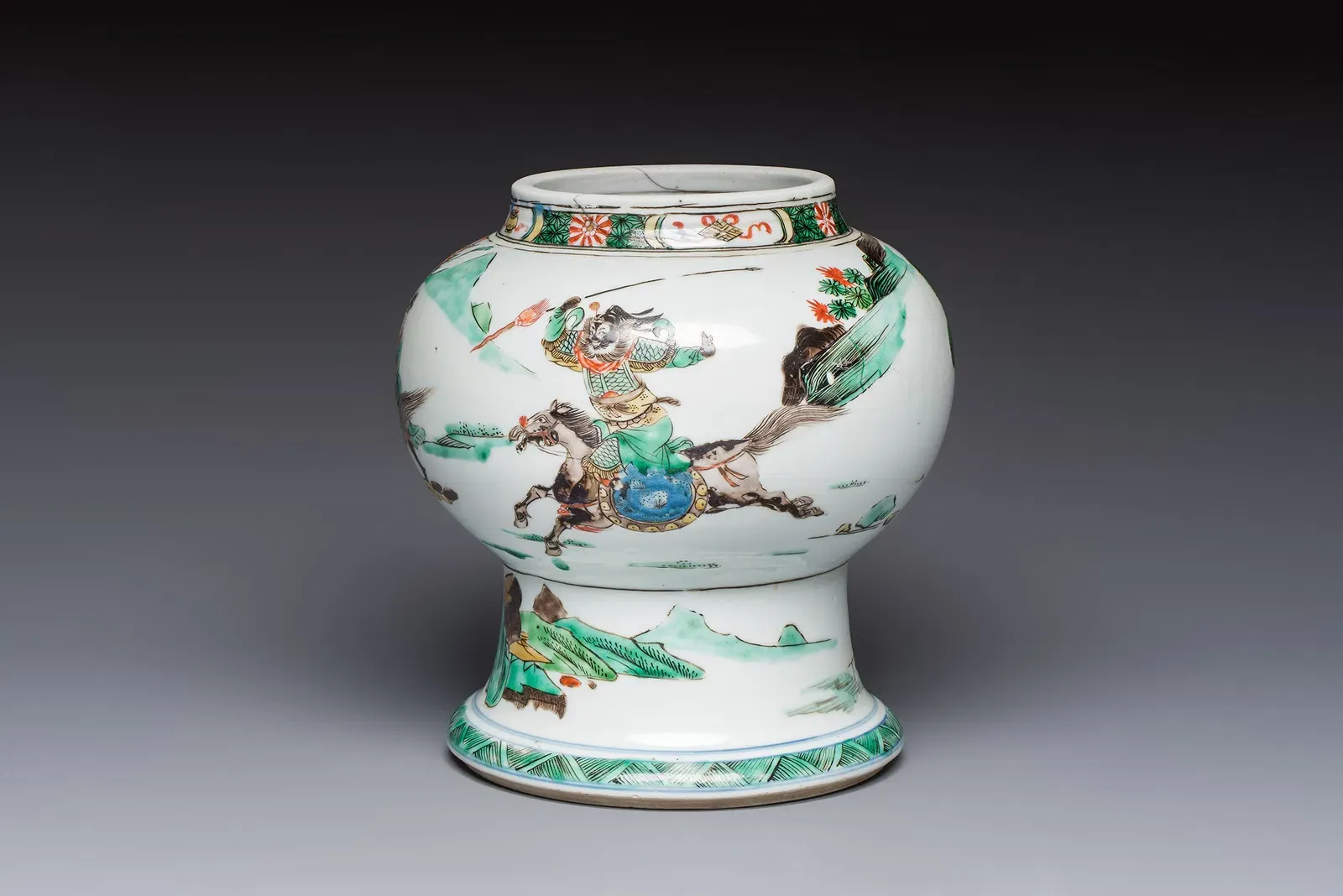
Chinese Famille Verte Porcelain Garden Seat中国五彩瓷园凳
LANGUAGE UNLOCK
Glossary Roundup
Original Presentation Script
Meet a lively Chinese famille verte porcelain garden seat, a form that comfortably straddles sculpture and furniture. It is the sort of object that would have animated a courtyard, scholar’s studio, or veranda, functioning as both practical seating and decorative centerpiece.
This example most likely dates to the late Qing dynasty to early Republican period, circa the late 19th to early 20th century. The famille verte palette—greens balanced with iron-red, black, and turquoise—along with the figural landscape scenes of scholars amid pine and rockwork, aligns well with decorative wares produced for both domestic use and export markets during that time.
The painting is freehand and expressive rather than tightly controlled, suggesting a workshop production intended for the decorative market rather than the imperial kilns. The underside reveals an unglazed footring and a faint red inventory mark, but no reign mark. A visible rim crack and general surface wear are consistent with age and use.
While precise dating within the late Qing to early Republican window cannot be definitively fixed without additional diagnostic evidence, the object presents as a period decorative work. Assuming it remains structurally stable, a fair market range for a comparable example would fall between $800 and $1,800, with condition and local demand playing meaningful roles.
Used for this report's TTS and avatar presentation.
Dating based on stylistic comparison; no reign mark present.
Style:Qing–Republican period famille verte
Origin:China
Materials:Porcelain, polychrome enamels
Age:Late Qing dynasty to early Republican period, circa late 19th to early 20th century
Condition:Good (visible rim crack, surface wear, no major structural restoration observed)
Value:Authentic period example: $800–$1,800; later decorative example: $150–$400
Peer-Reviewed Market Values
Dating Range
Pending structured dating
Auction Liquidation
Pending structured market values
Fair Market Value
Pending structured market values
Replacement Value
Pending structured market values
Comparables Used
5 comparables
Research Confidence
Complete
Peer review completed, but this run did not return structured market value ranges.
Maker's Marks / Writing:No discernible reign or maker’s mark; faint red inventory number on base
Date:2026-06-11 17:19:08.762589
Description:
A barrel-form porcelain garden seat decorated in famille verte enamels with figural and landscape scenes, including scholars, pine trees, and rockwork. The body is painted in green, iron-red, black, and turquoise tones. The underside shows an unglazed footring and base with a faint red inventory mark but no discernible reign or maker’s mark. The painting appears freehand and somewhat simplified, consistent with decorative rather than imperial-quality wares.
一件筒形瓷园凳,通体以五彩釉上彩绘人物山水题材,包括文士、松树与山石等纹饰。以绿色、铁红、黑彩与蓝绿色为主调。底部露胎,圈足未施釉,可见淡红色模糊编号,但无明确年款或款识。绘画风格较为随意简化,符合民间陈设瓷而非宫廷精品特征。
Curator Questions
Curated by Jade
Assessment:
A Chinese famille verte porcelain garden seat of decorative character, likely produced in the late Qing dynasty to early Republican period (late 19th to early 20th century). The barrel form, enamel palette, and figural landscape decoration are consistent with known examples of export and domestic decorative wares. The painting is lively but somewhat simplified, and no reign mark is present. A visible rim crack and general surface wear are consistent with age and use. While the precise dating within the late Qing to early Republican period cannot be definitively established without further diagnostic evidence, the piece reads as a period decorative work rather than a modern reproduction.
此件为中国五彩瓷园凳,整体风格属晚清至民国早期(约19世纪末至20世纪初)的陈设瓷。筒形器身、五彩釉色与人物山水题材均符合当时内销及外销装饰瓷特征。绘工生动但略显简化,未见明确年款。口沿可见裂纹及使用磨损,与年代及日常陈设使用相符。虽无法在晚清与民国早期之间作出精确断代,但整体观感更接近时代陈设器,而非现代仿品。
Individual Images:
Front view
three-quarter view
side view
back view
rim detail showing crack
underside base with footring and faint red mark
Provenance:
No provenance provided.
Condition:
Good (visible rim crack, surface wear, no major structural restoration observed)
Identification Score: 87%
The barrel form, famille verte enamel palette, and figural landscape decoration clearly identify the object as a Chinese porcelain garden seat. The unglazed footring and absence of modern transfer decoration support this identification. Higher-resolution images of the base and construction details would further strengthen certainty.
筒形器形、五彩釉上彩人物山水装饰,以及底部露胎圈足特征,都清楚表明其为中国瓷质园凳。未见现代贴花工艺痕迹。若能提供更清晰的底足与胎质细节图像,可进一步提高判断准确度。
Authenticity Score: 75%
Visible age-related wear, a rim crack, and freehand enamel decoration support period manufacture. The surface brightness and somewhat simplified painting suggest a decorative-grade example rather than a high imperial kiln product. In the absence of a reign mark or kiln-specific diagnostic features, attribution rests on stylistic comparison, but no strong indicators of modern mass production are evident.
可见自然磨损与口沿裂纹,加之手绘釉彩特征,支持其为时代制品。釉面较为明亮、绘工略简,显示其为民间装饰等级,而非御窑精品。虽无年款或明确窑口特征,仅能依风格断代,但未见明显现代批量仿制痕迹。
Image Memory Note
Barrel-form famille verte porcelain garden seat with rim crack and unglazed footring.
筒形五彩瓷园凳,口沿有裂,底部露胎圈足。
Fair Market Value
Pending structured market values
Replacement Value
Pending structured market values
Archived Matches
No archive matches yet
Research Confidence
Complete
Peer Review
Key Visible Evidence
The object is a barrel-form porcelain garden seat, decorated in the famille verte palette with figural and landscape scenes (Image 1, 2, 3). A visible crack is present on the rim (Image 1). The underside shows an unglazed footring and base, with a faint, illegible red mark, but no discernible reign or maker's mark (Image 6). The painting style appears freehand and somewhat simplified, consistent with decorative rather than imperial quality wares.
Market and Source Support
The famille verte palette and decorative program are consistent with Chinese porcelain production from the Qing dynasty into the Republican period. The general form and decorative style are broadly associated with late Qing export or domestic decorative wares. Without a specific reign mark or other dated inscription, the attribution to 'late Qing dynasty, circa 19th century' relies on general stylistic comparison rather than definitive historical dating.
Needs Verification
- Confirmation of the 'pierced top opening' as described, as it is not clearly visible in the provided images.- Higher-resolution images of the base and footring to ascertain any further faint marks or specific kiln characteristics.- Comparative examples of similar quality and decorative style with confirmed 19th-century dating would strengthen the age attribution.
Audit Conclusion
The report's identification of the object as a Chinese famille verte porcelain garden seat is well-supported by visible evidence. However, the dating to 'late Qing dynasty, circa 19th century' is plausible but unproven without specific diagnostic features or marks. The overall assessment is plausible but unproven regarding the precise 19th-century dating, requiring further verification.


Share: