Papua New Guinea Sepik River Polychrome Wood Spirit Mask with Feather/Bristle Edging
LANGUAGE UNLOCK
Glossary Roundup
Original Presentation Script
No narration for this appraisal report
Used for this report's TTS and avatar presentation.
Item Report
Papua New Guinea Sepik River Polychrome Wood Spirit Mask with Feather/Bristle Edging
By:Unknown carver (Sepik River workshop)
Style:Oceanic Art — Papua New Guinea, Sepik River (Middle Sepik) spirit/men’s house mask
Origin:Papua New Guinea (Sepik River region)
Materials:Carved tropical hardwood; natural pigments (kaolin/ochre/charcoal); feather or pig-bristle edging; possible plant fiber/adhesive for attachments
Age:Circa 1960–1980 (mid- to late-20th century, likely made for trade/display rather than ritual use)
Condition:Good (surface wear and pigment losses; minor edge abrasions; some loss/sparseness to feather/bristle edging; not officially graded)
Value:USD $150–300 at auction
Maker's Marks / Writing:No maker’s marks or inscriptions visible.
Date:2025-08-15 11:30:57.838546
Description:
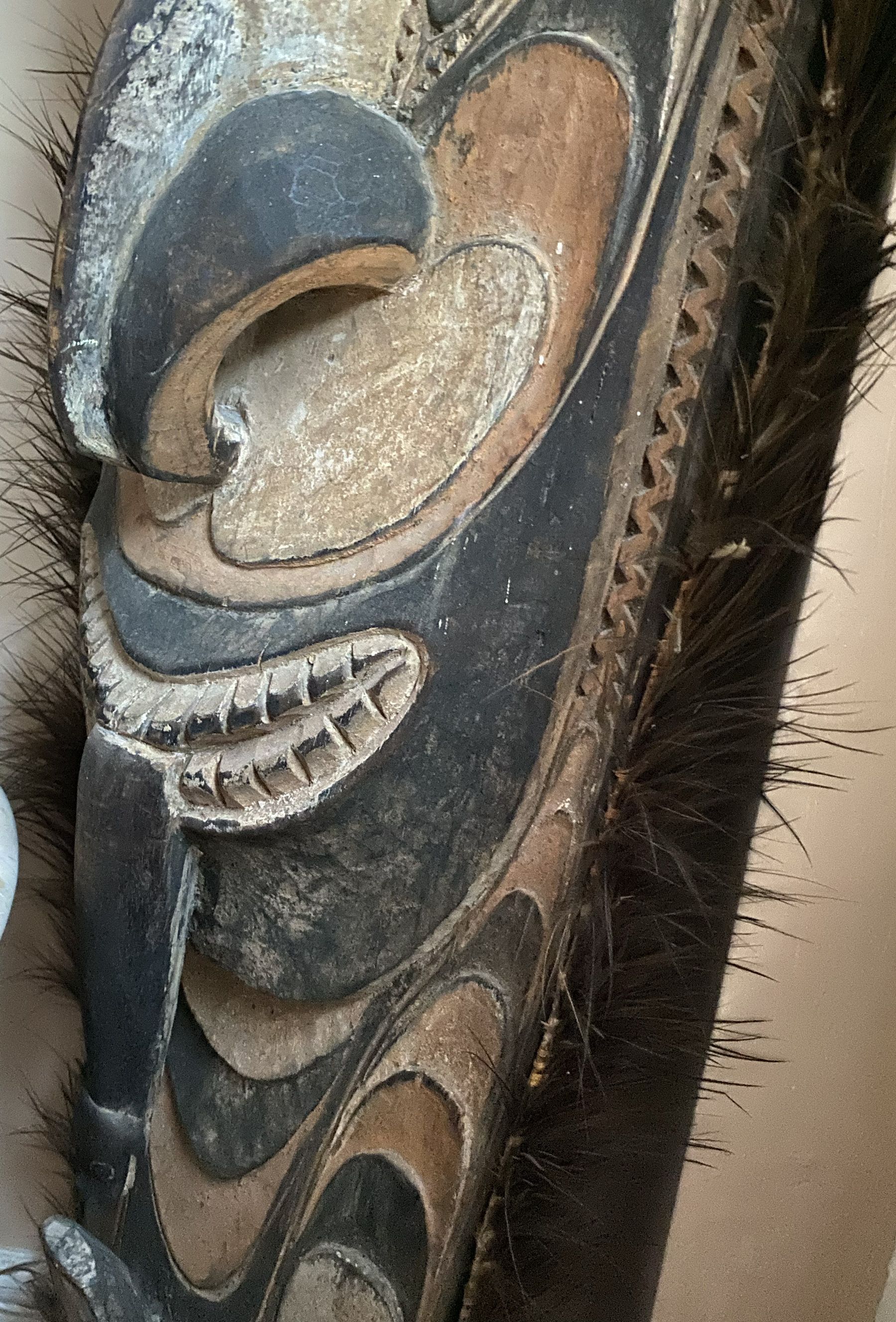
Tall carved wooden mask from the Sepik River region of Papua New Guinea, with a dramatically hooked, protruding nose, crescent-form eyes, and a carved, tooth-like crescent motif near the mouth. The surface shows traditional earth pigments—black (charcoal), white (kaolin), and reddish-brown/ochre—applied over a carved relief ground. The right edge displays a saw-tooth/chevron border with a line of drilled holes holding dark feather or pig-bristle tufts. Overall form and motifs are consistent with men’s house (spirit) masks from the Middle Sepik.
Curator Questions
Curated by Jade
Assessment:
This appears to be a Sepik River spirit mask of the type displayed in men’s houses (Haus Tambaran), executed with typical polychrome relief carving and a pronounced hooked nose. The crisp, fairly symmetrical carving, even surfaces, and the nature of the pigment wear suggest a mid- to late-20th-century production likely made for the tourist/ethnographic art market rather than a heavily used ceremonial piece. The feather/bristle edging and zig-zag drilled border are regionally appropriate details. A word about fakes.. Oceanic masks are widely reproduced; absence of clear ritual wear, smoke patination, or old fiber bindings keeps authenticity confidence modest. As decorative ethnographic art, it remains a desirable wall piece.
Individual Images:
Close-up images highlight the prominent hooked nose with surface craquelure and chalky kaolin residue; crescent eye motifs in relief; and a carved
tooth-like crescent near the mouth. The right margin shows a zig-zag/chevron carved border alongside a row of drilled holes that hold dark
stiff feather or bristle tufts—several tufts appear missing or shortened. Pigment layers show abrasions to high points
exposing wood; black areas have matte
charcoal-like finish. There are subtle tool marks but overall symmetry is relatively high
consistent with later workshop production. No backing view
suspension device
or interior carving is provided
which would have helped assess age and use.
Provenance:
Not provided.
Condition:
Good (surface wear and pigment losses; minor edge abrasions; some loss/sparseness to feather/bristle edging; not officially graded)
Identification Score: 85%
Form, motifs (hooked nose, crescent eyes, tooth-like carving), pigments, and feather/bristle edging strongly indicate a Sepik River spirit/men’s house mask. Minor uncertainty remains regarding sub-group and exact locality within the Sepik.
Authenticity Score: 30%
Surface presents uniform, relatively clean carving with generalized pigment wear and limited evidence of long ritual use (little smoke patina or sweat handling polish). Edge attachments appear comparatively fresh. In a category rife with reproductions, and absent provenance or interior/verso views, a trade/tourist piece from c. 1960–1980 is more likely than an earlier, ritually used mask.
Image Memory Note
Object: Vertical, elongated wooden mask in relief. Central features: long, strongly hooked nose protruding outward; almond/crescent eyes with relief rims; a carved crescent with tooth-like notches near the mouth area; multiple flowing, curvilinear relief bands on cheeks and lower face. Pigments: black (charcoal), white (kaolin/chalk), and brown/ochre; pigment losses on high points, especially nose bridge and cheek ridges; chalky white accretions visible. Borders: right-hand edge (as viewed) has a triangular saw-tooth/chevron border; adjacent row of drilled holes containing tufted dark feathers or stiff bristles along the length—some tufts missing or sparse. Texture: matte surface with visible wear and small abrasions; faint surface cracks/craquelure on the nose tip and bridge; minor chips along edges; possible small scrape at lower left jaw area. No visible signatures, stamps, or writing. No back view shown. Motifs are consistent with Papua New Guinea Sepik River men’s house/spirit masks.
Keywords
Papua New Guinea; Sepik River; Oceanic art; spirit mask; men’s house mask; polychrome wood; feather bristles; Middle Sepik
The report was edited after initial Artmink draft. Original AI draft preserved in Artmink audit history.

Share: