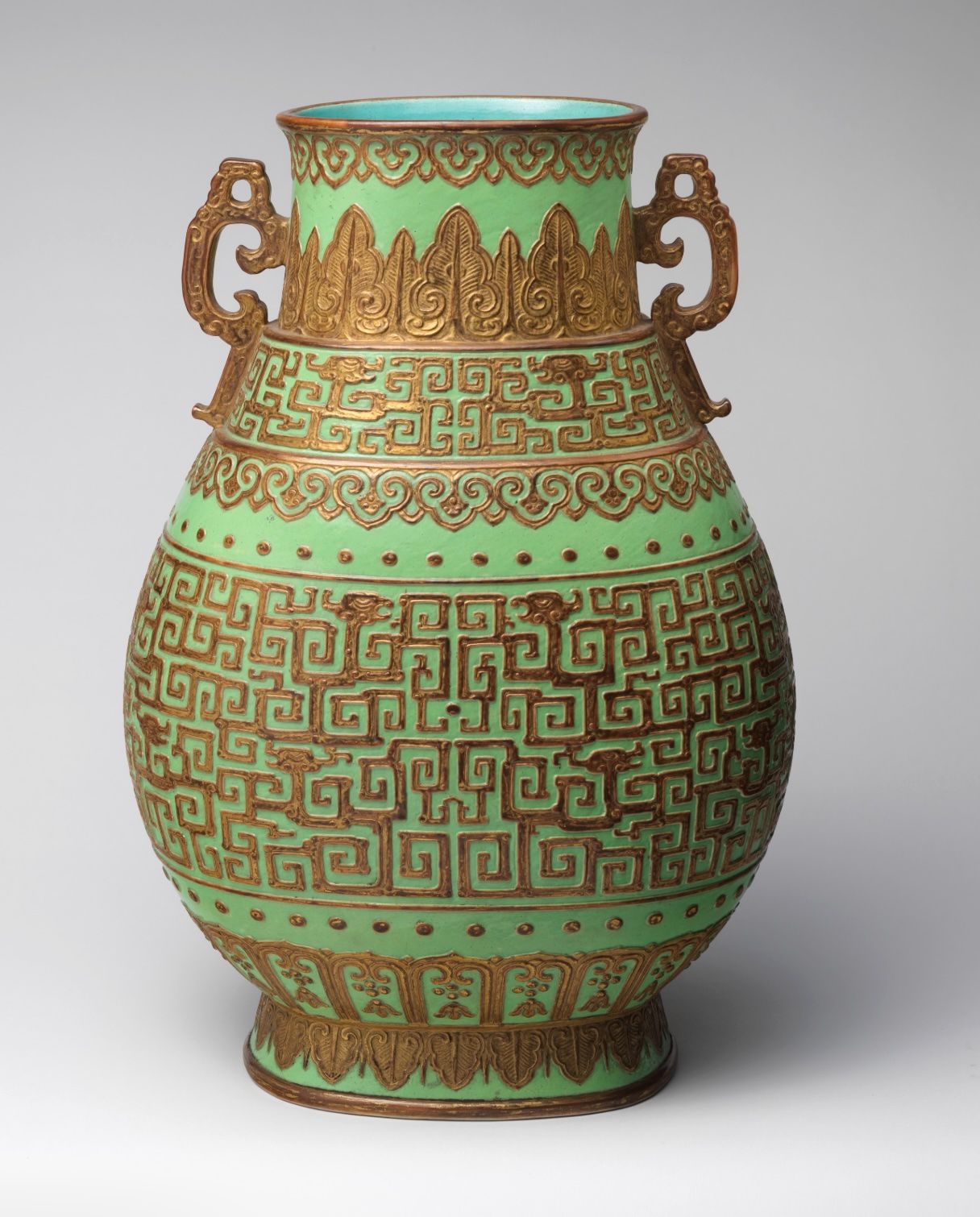
Let’s take a closer look at this imposing Qing Style Green-Ground Gilt-Relief Porcelain Hu-Form Vase. With its swelling ovoid body, twin scroll handles, and turquoise interior, it’s clearly modeled on the ancient bronze hu, reimagined in glossy ceramic finery.
Historically, this language of archaic bronzes translated into porcelain reaches its height under the Qianlong emperor, when the court delighted in reviving Shang and Zhou motifs. Here we see that same vocabulary: dense key-fret leiwen bands, stylized beast masks, ruyi scrolls, and lappet panels marching neatly around the foot.
The materials and workmanship are confident—porcelain body, bright green ground, raised slip outlining the motifs, all picked out in gold. The relief is sharp, the patterning regular, suggesting a disciplined workshop rather than a rough studio piece.
Condition, at least from these photographs, is very good: I see no obvious chips or cracks, just minor rubbing to the gilding and the usual kiln specks that attest to hand production. Nothing here screams hard usage over centuries.
Where it becomes interesting is authenticity in the strict sense of date. The freshness of the gilding and the evenness of the glaze point away from an 18th‑century imperial product and toward a 20th‑century archaistic piece. I’d place authenticity at about 45%, with auction value perhaps $4,000–8,000 if late Qing or Republic, but more like $300–800 if modern. Either way, it’s a striking statement of China’s enduring love affair with its own bronze age.
Used for this report's TTS and avatar presentation.
Materials:Porcelain body with green and turquoise glazes, raised slip decoration with gilding, iron-brown dressed rims
Age:Circa late 19th–early 20th century (Guangxu–Republic era), or later archaistic reproduction
Condition:Very good (no obvious chips or cracks visible; minor surface wear and kiln imperfections only, based on photos)
Value:If authentic late-Qing/Republic work: US$4,000–8,000 at auction. If a modern late-20th/21st-century reproduction: US$300–800.
Maker's Marks / Writing:No marks or inscriptions visible in provided images.
Date:2025-12-08 02:53:10.037418
Description:
Large porcelain hu-form vase with twin stylized dragon-scroll handles, covered in a bright celadon‑green ground. The exterior is decorated in raised slip and gilt with archaistic key‑fret (leiwen) bands incorporating stylized animal masks, ruyi scroll borders, and pendent plantain and lappet panels above the foot and at the shoulder. Interior is turquoise glazed; mouth and foot rims show iron‑brown dressing. The overall design consciously emulates archaic bronze ritual vessels, translated into richly encrusted Qing‑style ceramic decoration.
大型瓷质胡瓶,通体呈鼓腹高颈,肩部两侧饰对称夔龙式耳。外壁施明亮的青釉绿地,其上以堆塑并描金装饰,主体为仿商周青铜器的雷纹回字纹,并间以夔龙兽面纹、如意云头纹带以及蕉叶、莲瓣形垂饰纹等。内壁施松石蓝釉,口沿与足沿见铁锈色釉线。整体造型与纹饰明显仿效古代青铜礼器的胡瓶式样,以清代华丽的装饰手法加以演绎。
Curator Questions
Curated by Jade
Assessment:
Form, palette, and decoration strongly reference Qing imperial archaistic taste—particularly Qianlong-era bronze-inspired porcelains—with hu form, turquoise interior, and gilt-relief key‑fret bands. The glaze and gilding appear even and relatively fresh, with limited abrasion to high points; there is some kiln speckling and minor firing imperfections consistent with hand‑made porcelain. Without a view of the base or any reign mark, it is difficult to anchor the piece securely in the late Qing–Republic period versus a high-quality modern workshop piece emulating that style. The crispness of the slip relief and the bright, uniform green suggest a later date, yet the overall design is sophisticated and coherent. A word about fakes.. this category—archaistic Qing‑style porcelains with heavy gilt relief—is heavily reproduced today, often with convincingly ‘old’ surfaces, so caution is essential. On balance I lean toward a 20th‑century archaistic example rather than an 18th‑century original, and have valued it accordingly. - CHOP goes of my red seal stamp!
此瓶的造型、釉色与装饰明显承袭清代宫廷仿古审美,尤似乾隆时期仿青铜瓷器的风格:胡瓶式样、内施松石蓝釉、外壁绿地描金雷纹与夔龙纹皆属其典型语汇。从细部看,堆塑线条较为利落规整,绿釉色泽明亮均一,描金磨损不多,仅见局部轻微擦痕与窑内小黑点、缩釉等手工烧造痕迹。由于缺乏底款与足底照片,难以将其确切归入晚清至民国早期,或是近代仿制品。堆塑浮雕的清晰度与釉色的鲜艳度略偏近现代作品,但整体设计老练统一,制作颇为讲究。A word about fakes.. 此类带厚重描金浮雕、仿古青铜纹样的清式瓷器在当今市场被大量翻烧,仿旧手法层出不穷,需格外谨慎。综合各项因素,我倾向认为本品为20世纪仿乾隆风格的清式器,而非18世纪御窑原作,并据此给出估价。 - CHOP goes of my red seal stamp!
Individual Images:
none
Provenance:
Not provided.
Condition:
Very good (no obvious chips or cracks visible; minor surface wear and kiln imperfections only, based on photos)
Identification Score: 90%
Shape, handles, green ground with turquoise interior, and gilt-relief archaistic decoration clearly identify this as a Qing-style archaistic porcelain hu vase, likely from or emulating Jingdezhen production.
依据胡瓶造型、双夔龙耳、绿地松石蓝内壁以及描金雷纹等典型元素,可相当确定地将其归类为清式仿古风格的瓷胡瓶,应出自或仿自景德镇体系,故识别置信度较高。
Authenticity Score: 45%
While the design language matches Qing imperial archaistic taste, the freshness of gilding, very even glaze, and lack of clear age-related wear suggest a 20th‑century archaistic piece or modern reproduction rather than an 18th‑century imperial original; without base and mark views, I must assume later production.
虽然纹饰语汇与乾隆宫廷仿古器相符,但描金保存过于清新、釉面光洁均匀、缺乏长期把玩与陈设所致的自然磨蚀,更符合20世纪仿古器或近代作坊产品的特征,而非18世纪御窑老器。在未见底款与足底结构前,只能保守视为后期制作,故真品年代可靠性评分偏低。
Image Memory Note
None
None
Keywords
Qing style, archaistic, Chinese porcelain hu vase, green ground, gilt relief, turquoise interior, China
清式, 仿古, 中国瓷胡瓶, 绿地, 描金浮雕, 松石蓝釉内, 中国
The report was edited after initial Artmink draft. Original AI draft preserved in Artmink audit history.

Share: