Japanese Edo Period Iron and Lacquer Samurai Armor (Tōsei Gusoku)日本江户时代铁与漆武士铠甲套装(当世具足)
LANGUAGE UNLOCK
Glossary Roundup
Original Presentation Script
Let’s spend a moment with this imposing Japanese Edo Period Iron and Lacquer Samurai Armor — a full tōsei gusoku set that looks ready to stride straight out of a Kurosawa epic.
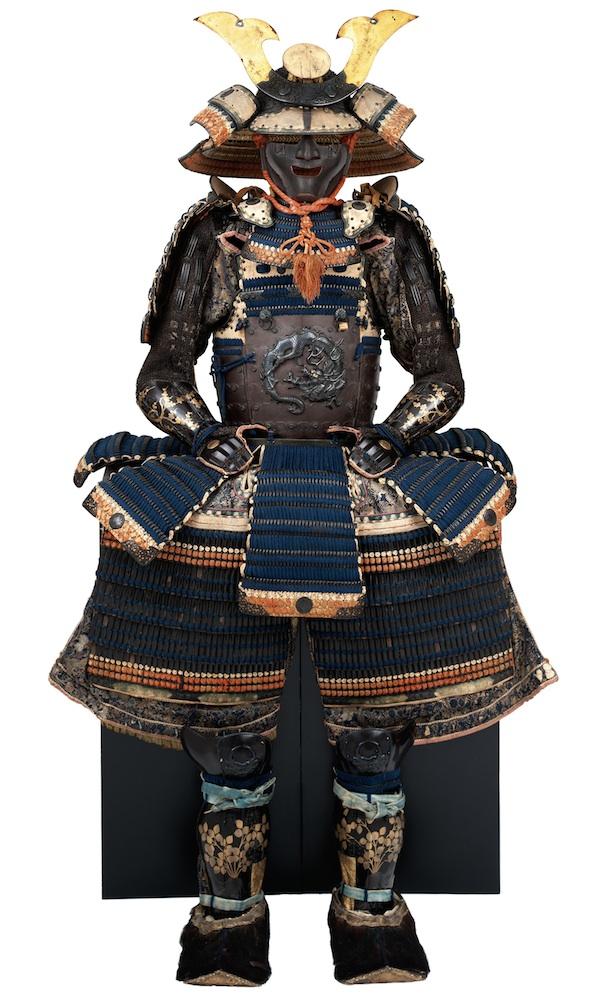
We have the complete ensemble: a boldly crested kabuto helmet, a dark menpō mask with fierce expression, and a cuirass embossed with a swirling dragon. Blue silk lacing ties together bands of lacquered iron and rawhide, cascading into that flaring skirt of kusazuri plates. It’s not just costume; it’s mobile fortification with theatrical flair.
Historically, this type of armor belongs to the long peace of the Edo period, when warfare receded and status display took center stage. Dragons and oversized kuwagata weren’t merely decoration; they broadcast rank, taste, and a carefully curated ferocity.
Look closely at the surface: the mottled lacquer, softened edges to the plates, and tired textiles suggest genuine age, while the overall completeness and visual harmony hint at later assembly and restoration — very typical for armors prepared for export and museum-style display.
On the authenticity spectrum, I’d place this around 55 out of 100: likely composed largely of Edo-period elements, but probably not a purely original, single-owner suit. At auction, that translates to something in the region of $40,000–70,000 if confirmed period and well-attributed, while a mostly modern composite would fall closer to $3,000–8,000.
Either way, it’s a powerful object — a carefully staged conversation between battlefield history and modern display culture.
Used for this report's TTS and avatar presentation.
Item Report
Japanese Edo Period Iron and Lacquer Samurai Armor (Tōsei Gusoku)
日本江户时代铁与漆武士铠甲套装(当世具足)
By:Unknown armorer (katchū-shi), Japan
Style:Edo period samurai armor, tōsei gusoku
Origin:Japan
Materials:Lacquered iron plates, leather, silk lacing, textile, gilt copper alloy fittings, yak hair
Age:Circa late 17th–early 18th century (Edo period), with later restorations and possible assembled components
Condition:Good (age-consistent wear, likely restorations and composite assembly)
Value:If largely period and traditionally assembled: US$40,000–70,000 at auction; if a modern composite or reproduction: US$3,000–8,000
Maker's Marks / Writing:No maker’s signature or lacquer inscription visible in the provided image.
Date:2025-12-27 23:03:28.540116
Description:
A complete suit of Japanese samurai armor comprising kabuto helmet with large gilt kuwagata crests, russet-iron menpō facial mask with moustache and yak-hair chin tufts, dō cuirass with embossed dragon mon, kusazuri skirt, sode shoulder guards, kote arm guards, haidate thigh protection and suneate shin guards. The lamellar plates are laced in blue and buff silk odoshi with lacquered iron and rawhide scales, retaining many original textile elements. Presented on a modern black display stand.
一整套日本武士铠甲,包括配有大型鎏金锹形前立的兜盔、带髭须与兽毛髯的褐铁面颊甲(面頬)、浮雕龙纹胴铠、条形草摺裙、袖甲、籠手臂甲、佩楯腿部护具以及脛当护胫。甲片以蓝色与米色丝绸威绳联结,配合涂漆铁片与生皮札,保留了大量原始织物。现装配于一座现代黑色陈列架上。
Curator Questions
Curated by Jade
Assessment:
This is a visually impressive suit of Japanese tōsei gusoku armor in the Edo-period style, with elaborate dragon-decorated cuirass, bold kuwagata crests, and blue silk lacing. The patina on the lacquered iron, the wear to the textile components, and the complexity of the construction suggest that a significant portion of the set is of Edo-period origin, though it is likely somewhat composite and partially restored, as is typical for export and display armors. A word about copies.. samurai armor is widely reproduced and many modern workshop sets imitate Edo styles using new iron and artificially aged textile, so caution is essential when assigning value. On photographic evidence alone, this reads as a good to very good quality antique or partly antique armor assembled for display, suitable for a serious decorative collection or entry-level arms and armor collection rather than as a fully original clan-specific masterpiece.
这套铠甲外观震撼,为典型江户时代样式的当世具足,具备龙纹胴铠、醒目的锹形前立以及蓝色丝威绳等华丽要素。从漆铁表面的包浆、纺织部分的磨损以及结构的复杂程度来看,其中相当部分应为江户时期制作,但整套可能由不同部件拼组,并辅以后期修复,这在外销与陈列用铠甲中十分常见。A word about copies.. 武士铠甲领域赝品与复刻极多,现代工坊常以新铁与仿旧织物仿制江户样式,因此在估值时必须格外谨慎。仅凭照片判断,这更接近一套品质良好的古董或半古董陈列铠甲,适合严肃装饰或入门级兵器收藏,而非完全原装、具有特定家纹传承的一流名品。
Individual Images:
whole samurai armor front view
Provenance:
Not provided; no documentation visible.
Condition:
Good (age-consistent wear, likely restorations and composite assembly)
Identification Score: 92%
Overall form, components (kabuto, menpō, dō, sode, kusazuri, kote, haidate, suneate), lacing style, and dragon relief match well-documented Edo-period tōsei gusoku samurai armor; while individual school or maker cannot be specified, the category is clear.
兜、面頬、胴、袖、草摺、籠手、佩楯、脛当等部件齐全,结构与威绳方式与文献中记载的江户时代当世具足高度吻合;虽无法具体到流派或工匠名号,但类型判断相当明确,因此给出较高识别分数。
Authenticity Score: 55%
Patina and wear on lacquer and textiles suggest real age, yet the armor presents as unusually complete and visually unified, which often indicates a composite set assembled from period and later parts or mixed with reproduction elements. Without hands-on inspection of interior plates, rivets, and textiles, I must assume partial originality with possible modern components and restorations.
漆面与织物的磨损呈现出一定年代感,但整套铠甲过于完整且视觉上极为统一,这在市场上往往意味着由不同年代部件拼组,或掺有现代复制零件与修复。由于无法实物检查内侧甲片、铆钉与织物结构,只能保守认为其为“部分真品+可能的后补部件”的组合,因此真实性评分偏中等。
Image Memory Note
None
None
Keywords
Japanese samurai armor, Edo period, tōsei gusoku, kabuto, menpo, lacquered iron, arms and armor, Japan
日本武士铠甲, 江户时代, 当世具足, 兜, 面頬, 漆铁, 兵器护具, 日本
The report was edited after initial Artmink draft. Original AI draft preserved in Artmink audit history.

Share: