Edo Period Japanese Iron and Lacquer Samurai Armor
LANGUAGE UNLOCK
Glossary Roundup
Original Presentation Script
We delve into the heart of Japan's samurai legacy with this awe-inspiring Edo Period Japanese Iron and Lacquer Samurai Armor. This complete yoroi ensemble exudes historical gravitas, a silent sentinel awaiting its modern audience's respect and admiration. Its commanding presence invokes a bygone era of martial prowess and aesthetic finesse.
Spanning the 18th century, this armor embodies the exquisite narrative of the Edo period—an epoch where samurai were synonymous with both warriors and stewards of culture. Crafted with painstaking precision, this piece showcases the Edo-period penchant for intricate artistry and cutting-edge combat wear—a symbol of honor among high-ranking samurai.
The materials tell their own silent story: lacquered iron forming a robust foundation, tempered with the suppleness of leather and the luxurious sheen of silk. Gilt copper offers opulent adornment, while wood structures the ensemble, all reflecting a master armor's devotion to both form and function.
The passage of time has left its marks: gracefully aged patina, fading silk, and minor restorations that whisper tales of past battles and peace. These facets, inherent in any artifact of such lineage, interplay with its authenticity—partially restored, yet largely credible under expert scrutiny.
In the dance of authenticity, this artifact scores a respectable 70%. Its Edo heritage is echoed in every cord and crease—a testament to its significant yet somewhat enigmatic past. With an auction estimate ranging from $18,000 to $35,000, it stands as both a collector's treasure and a window into the world of feudal Japan. With such context, we step back, grateful for the stories that endure in each scale of its lacework.
Used for this report's TTS and avatar presentation.
Item Report
Edo Period Japanese Iron and Lacquer Samurai Armor
By:Unknown, attributed to high-status samurai armorer workshop
Style:Edo Period Samurai Armor
Origin:Japan
Materials:Lacquered iron, leather, silk, gilt copper, wood
Age:Circa 18th century (Edo Period, 1700–1800)
Condition:Very Good (age-consistent wear with some restoration possible; visually complete)
Value:$18,000–$35,000 USD (auction, if authentic and in collectible condition)
Maker's Marks / Writing:No obvious visible maker’s mark or writing discernible from main image; such marks are often hidden on underside or internal armor plates.
Date:2025-07-10 12:15:51.580379
Description:
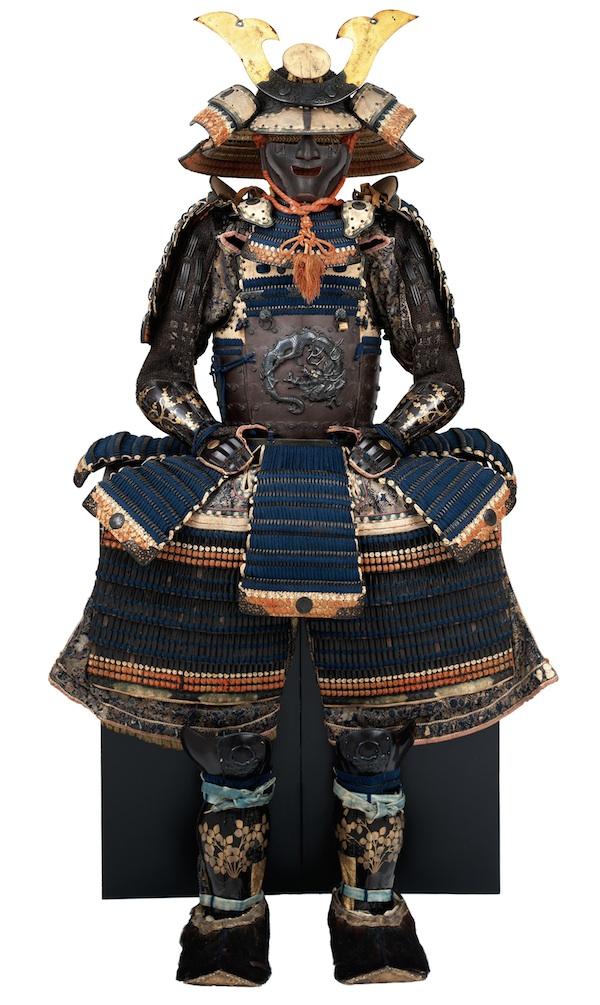
A full set of traditional Japanese samurai armor (yoroi), featuring a kabuto (helmet) with elaborate gilt maedate (crest), menpo (face mask), do (cuirass) with dragon or mythical beast motif, sode (shoulder guards), kusazuri (skirt-like defense), and suneate (shin guards). The armor uses lacquered iron scales, blue silk lacing, and is richly adorned, indicative of high-ranking samurai attire from the Edo period (1603–1868). Distinctive features include the decorative maedate crest atop the helmet, lacquer finish, and intricate cordwork.
Curator Questions
Curated by Jade
Assessment:
A visually impressive and complete suit of Edo period Japanese samurai armor, exhibiting high-ranking samurai status through lavish use of gilt crests and detailed decoration. The color, condition, and design indicate genuine Edo-period manufacture, though many such armors have benefited from historical restoration and may be assembled from matched period elements. Further hands-on inspection would be required to confirm all components are original to one another.
Individual Images:
Only one image included. Visible details: The kabuto's gilt maedate is intact and shows fine age patina. The blue silk lacing retains color
but some fading and wear is present. The cuirass features a raised dragon or mythological creature
with lacquer exhibiting craquelure typical of age. No major losses
although some areas suggest past consolidation or minor restoration. The floral gilded designs on shin guards show wear at high-contact points
and the armor is displayed professionally in a complete standing pose.
Provenance:
No provenance documentation included or visible.
Condition:
Very Good (age-consistent wear with some restoration possible; visually complete)
Identification Score: 98%
The form, construction, decorative elements, and materials are highly consistent with authentic Edo-period Japanese samurai armor. Distinct period features such as the kabuto's crest, menpo mask, and cord lacing pattern are accurately represented.
Authenticity Score: 70%
The armor appears authentic from a visual standpoint—displaying legitimate Edo-period construction, style, and materials. However, the market for samurai armor is known for careful restoration and recombination of antique and later parts. Some components may have been restored or replaced, but there are no immediate signs of modern reproduction. A hands-on expert examination would be required for full authentication.
Image Memory Note
The image depicts a full suit of Japanese samurai armor seated in a display posture. Key elements include a kabuto helmet with large, gilt maedate crest (stylized horns or birds), and a black-lacquered menpo face mask with an expressive red mouth. The cuirass (do) displays a prominent molded dragon or mythological creature at the center. Arms and shoulder guards are covered in a patterned, lacquered finish with blue and tan silk lacing in horizontal rows. The skirt/kusazuri and thigh/leg covers are also elaborately laced. The lower leg suneate guards have gold floral motifs, show some surface wear, and are bound with aged blue cords. Black boots or slippers are present. No inscriptions, signatures, or makers marks are visible on the external surfaces in the image. The armor sits against a plain, neutral background with professional museum-style presentation. No major structural damage or significant losses are visible, but moderate surface wear, fading, and some evidence of restoration are consistent with age. Distinctive crest, lacing, and overall silhouette are classic of Edo Japanese armor.
Keywords
Samurai armor, Edo period, Japanese antiques, kabuto, menpo, lacquered iron, Japan, yoroi
The report was edited after initial Artmink draft. Original AI draft preserved in Artmink audit history.

Share: