
One finds, in the realm of English Fine and Decorative Arts, certain objects that possess a peculiar duality. They are, on the one hand, deeply civilized, crafted for the quiet rituals of domestic life. Yet, they carry, on the other, a martial backstory, a whisper of duty and camaraderie. Such is the case with this handsome Victorian Period Irish Silver Presentation Teapot, a piece that elegantly bridges the drawing-room and the parade ground.
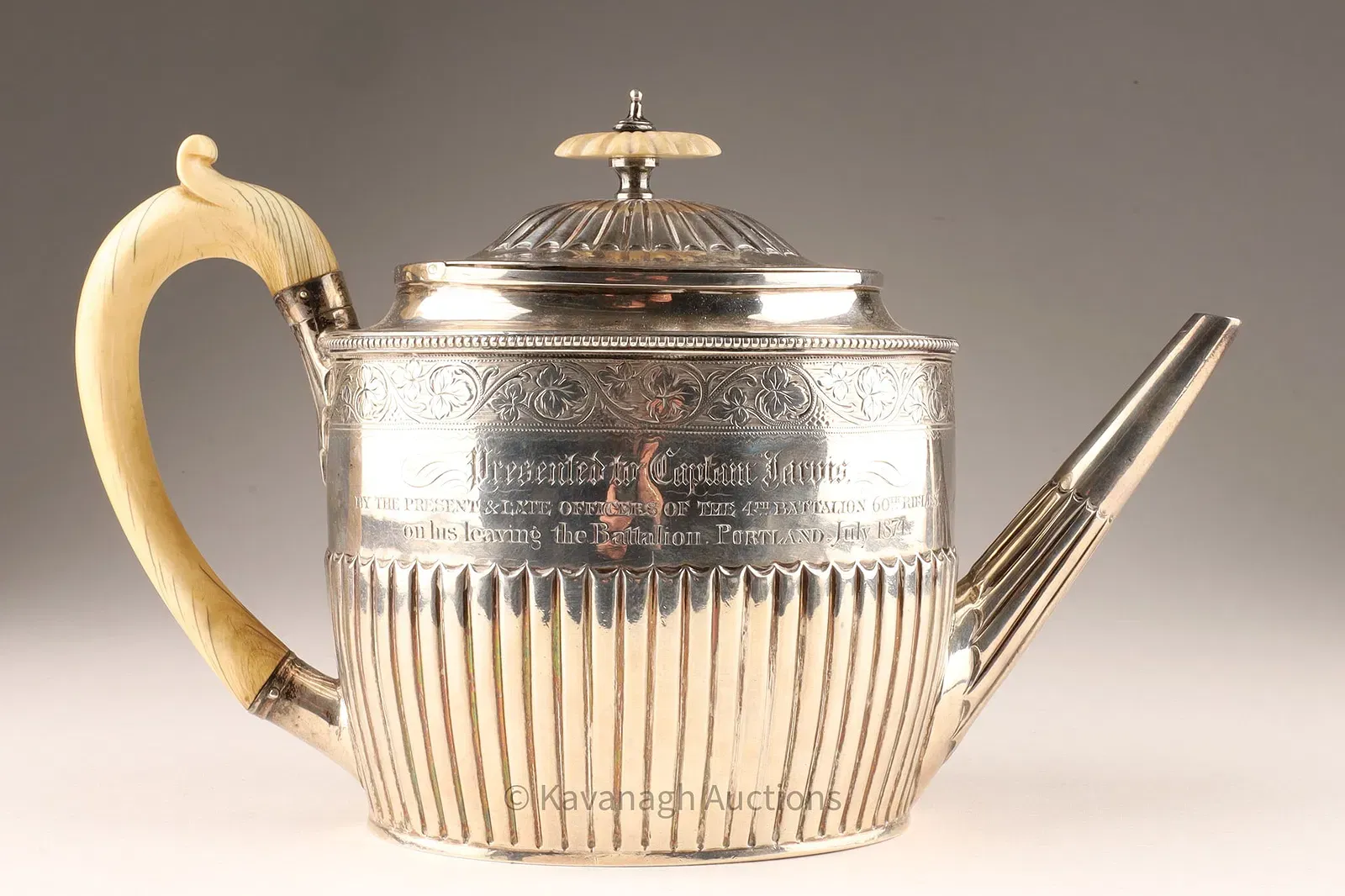
Fashioned from sterling silver, this teapot presents a classic baluster form, its lower body adorned with crisp vertical fluting that catches the light with a pleasing rhythm. Above this, a bright-cut and engraved foliate border encircles the body, a testament to the era's penchant for intricate detail. The hinged domed lid, with its restrained classical elegance, is crowned by an ivory finial, echoing the gracefully carved ivory handle. These ivory appointments were not merely decorative flourishes; they were practical, too, offering a comfortable, heat-resistant grip, a thoughtful luxury for a busy tea table.
What truly elevates this teapot beyond a mere domestic utensil is its poignant inscription. Clearly engraved on its body are the words: 'Presented to Captain Jarvis, by the present & late officers of the 4th Battalion 60th Rifles on his leaving the Battalion. Portland. July 1874.' This dedication places the piece squarely within the great 19th-century tradition of military and civic presentation silver. Such objects were more than just gifts; they were, as one might say, 'repositories of memory and status,' tangible expressions of appreciation, honouring service, marking significant departures, and cementing bonds of fellowship. For a collector, this direct link to a specific individual and a military unit of the Victorian era adds an invaluable layer of historical narrative and provenance.
For the discerning collector, the underside of such a piece often tells the most compelling story. Here, multiple hallmarks confirm its Irish origin and sterling standard. We find the Hibernia mark, indicating Dublin assay, alongside the Harp Crowned mark, certifying the sterling silver standard. Crucially, the Queen Victoria's head duty mark is also present, placing the piece firmly within her reign. While initial assessments were cautious, a closer examination, as noted in the peer review, reveals the maker's mark 'TB' to be 'clearly visible... and can be confidently attributed to Thomas Brady,' a known Dublin silversmith active during this period. Furthermore, the date letter 'T' in a shaped shield is 'also clearly discernible,' pinpointing the assay year to 1874-1875. The retailer's stamp, 'WEST & SON COLLEGE GREEN DUBLIN,' further grounds the piece in the vibrant silversmithing tradition of Ireland's capital, a firm renowned for its quality wares.
The question of authenticity is paramount when acquiring antique silver. In this instance, the combination of clear hallmarks, the well-documented retailer, the period-appropriate engraving style, and the use of luxury materials like ivory all speak to its genuine nature. The condition, too, offers clues. One observes light scratching to the base and expected polishing, consistent with a working presentation piece that has been cherished and used over the decades. Importantly, this wear appears honest, not contrived, a subtle but significant detail that separates a true antique from a modern pastiche. Reproductions, by contrast, often lack the nuanced wear patterns and the crisp, hand-finished quality of genuine Victorian craftsmanship.
What, then, makes such a piece a significant collector's item? Beyond its intrinsic beauty and material value, it is the confluence of historical context, impeccable craftsmanship, and verifiable provenance. Presentation silver, unlike standard silverware, is often bespoke, created for specific occasions and bearing personalized engravings that transform it into a unique historical document. These items offer a tangible connection to the past, allowing collectors to engage directly with the lives and stories of those who once celebrated with such opulent offerings. The rarity and the specific historical narrative embedded in each inscription significantly enhance their desirability and market value.
For those considering collecting or investing in Victorian Irish silver, understanding these nuances—from the specifics of hallmarking to the socio-cultural context of presentation pieces—is invaluable. It transforms the act of acquisition into a journey through time, making each piece a dialogue with history and craftsmanship. The market often rewards pieces with clear provenance and compelling stories, and this teapot, with its precise dedication and confirmed Dublin origins, certainly fits the bill.
Indeed, the appeal of Victorian Irish silver extends far beyond its functional beauty. It is a testament to an era of refined taste, meticulous artistry, and deeply held traditions. A truly charming object, this teapot invites us to ponder the lives it touched and the stories it silently holds. Let the Mink have a Think!