Step into any serious mid-century game room, and you might spot a machine that plays a brilliant visual trick on you. It stands tall on wooden legs, boasts a brightly lit headboard, and features a horizontal playboard covered in glass. Your brain immediately registers it as a classic flipper pinball machine. But step closer, look down at the playfield, and you will notice something entirely missing: the flippers. Welcome to the transitional era of early 1960s arcade design. This was a brief, beautiful window where the literal "pin" ball machines—games relying on a forest of metal pins and numbered holes—adopted the aggressive, modern stance of the flipper cabinets that would soon render them obsolete. As one historical analysis notes, these machines were "visually part of the post‑war flipper age, mechanically descended from pre‑flipper bagatelle and pinball."
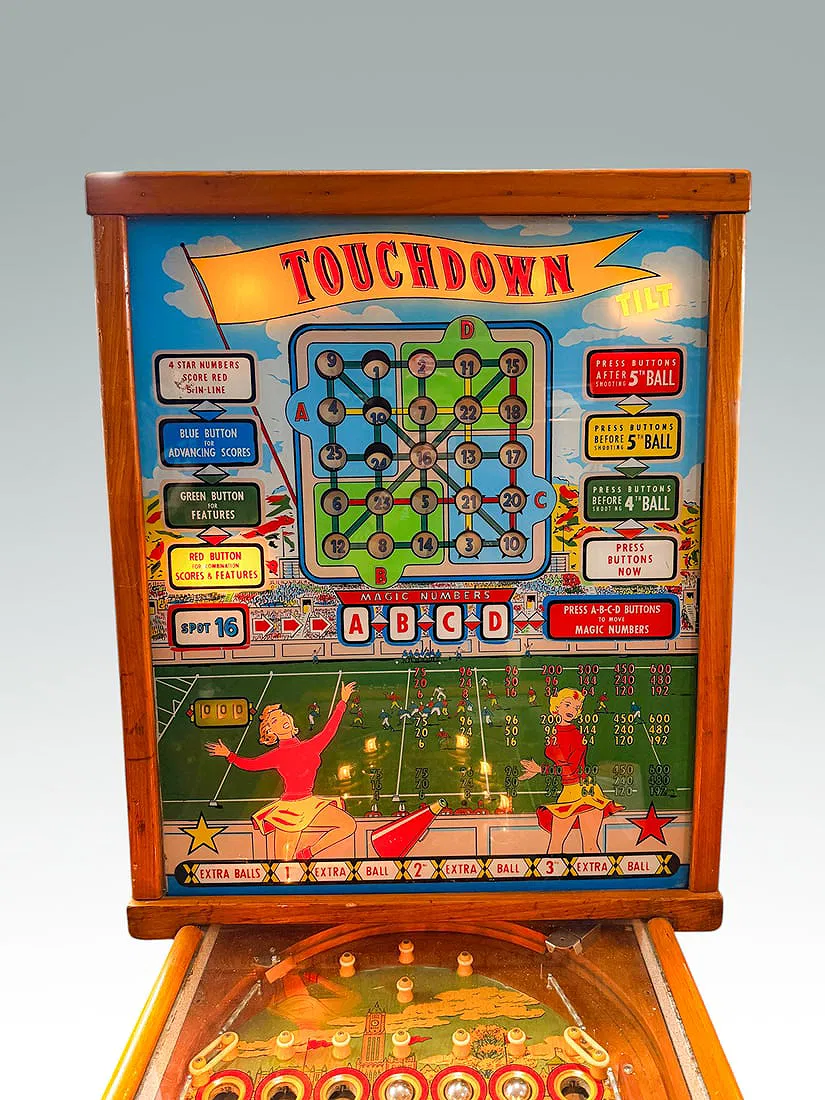
To understand this shift, we have to look at the titans of the coin-op industry, specifically the Bally Manufacturing Company. Their 1960 'Touchdown' bingo pinball machine is a perfect specimen of this era. Wrapped in a sturdy wooden cabinet painted in vibrant orange and yellow, the machine captures the lively, optimistic energy of mid-century Americana. The backglass is a riot of bold, colorful graphics featuring cheerleaders and a grid-based scoring system. Yet, the gameplay is entirely rooted in the past. Unlike modern pinball, "bingo pinball is all about skill and a bit of luck, aiming to land balls in specific numbered holes to create winning lines on the backglass grid."
The 'Touchdown' model utilized complex electro-mechanical components, including a "Magic Numbers" feature that allowed players to shift the scoring grid mid-game. It is a masterclass in robust period craftsmanship, complete with original paper instruction cards, Allied Printing Trades Council union labels, and the iconic red plastic "A Bally Product" badge. But mechanically, it represents a "gorgeous evolutionary dead-end in pinball history."
Bally and their competitors at United dominated this weird, wonderful overlap throughout the 1950s and early 1960s. If you are hunting for these transitional cousins, the lineage is clear. Bally pushed out bingo titles like "Beach Club" in 1953, "County Fair" in 1959, and "Show Time" in 1960. United answered with their own bingo lines, including "Can-Can" in 1955 and "Circus" in 1958. There were even hybrid crossover attempts, such as Bally's "Miss America ’62/’63," which finally introduced flippers alongside the traditional bingo-style scoring features.
However, the writing was on the arcade wall. By the mid-1960s, the pin-field and bingo logic were effectively banished from mainstream game design. When Gottlieb released Majorette in 1964, the transition was complete. Majorette was squarely in the modern flipper era: no forest of pins, no bingo card on the backglass, just clear flipper play, lanes, pop bumpers, and targets. The poker-themed machines that followed in 1965, like Gottlieb’s Kings & Queens and Bank-A-Ball, cemented this new reality. Their layouts were pure flipper-era design, leaving the transitional bingo and bagatelle formats in the dust.
Beyond the mechanical evolution, these transitional machines also tell a sharp story about mid-century coin-op economics. If you look at the original scoring cards on a 1960 Bally 'Touchdown', you will see the bold declaration: "5 BALLS 10 CENTS." In that era, a dime bought a full game, effectively offering two plays for a quarter with a nickel left over in your pocket.
By the 1970s, the dime was entirely dead in the coin-op world. Operators moved pinball machines, jukeboxes, and soda fountains to a strict 25-cent base unit. The "5 balls for a dime" era became a fond memory. Early 1970s arcades shifted to one play for a quarter. By the mid-to-late 1970s, as solid-state digital score displays replaced the electro-mechanical reels, operators adjusted to three plays for a quarter. Suddenly, players were racking up six-figure scores, a massive psychological leap from games like Majorette a dozen years prior, where hitting a bumper might award literally one single point.
For today's collectors and dealers, these flipperless transitional machines require a specific eye. Their value depends heavily on internal completeness. The exterior might show authentic, charming wear—scuffs on the painted cabinet and patina on the instruction cards—but the real investment lies beneath the glass. The internal relays, stepper units, and motors must be present and capable of being brought to full working order. Furthermore, the reverse side of that massive, brightly lit backglass must be inspected for common age-related issues like ink flaking, bubbling, or delamination. When found in complete, restorable condition, a classic bingo pinball machine from this era is a highly desirable asset, with auction estimates for a solid 1960 Bally 'Touchdown' typically ranging between $800 and $1,500. They capture the exact moment when the old-school bagatelle put on a sharp mid-century suit and prepared to hand the arcade over to the flipper generation.
Mid-Century Modern Marilyn reporting!