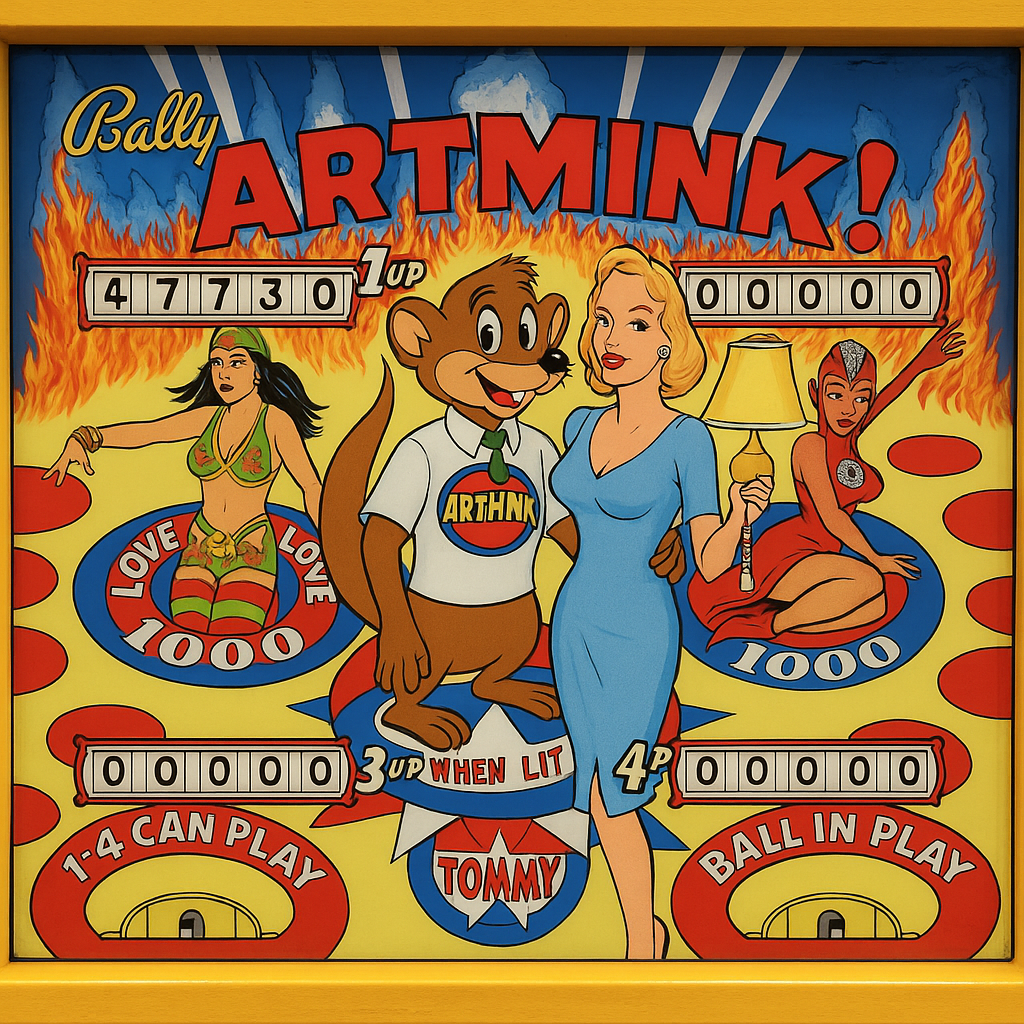
Darling, before the pixelated invaders of the late '70s stormed our arcades, there was a different kind of magic: the glorious, clattering symphony of electro-mechanical pinball. And if you wanted to talk about the apex of that era's art and culture, you simply *had* to mention Bally's 'Wizard!'. This wasn't just a game; it was a cultural touchstone, a vibrant, flashing testament to Mid-Century ingenuity meeting psychedelic pop art, all wrapped up in a four-player thrill ride.
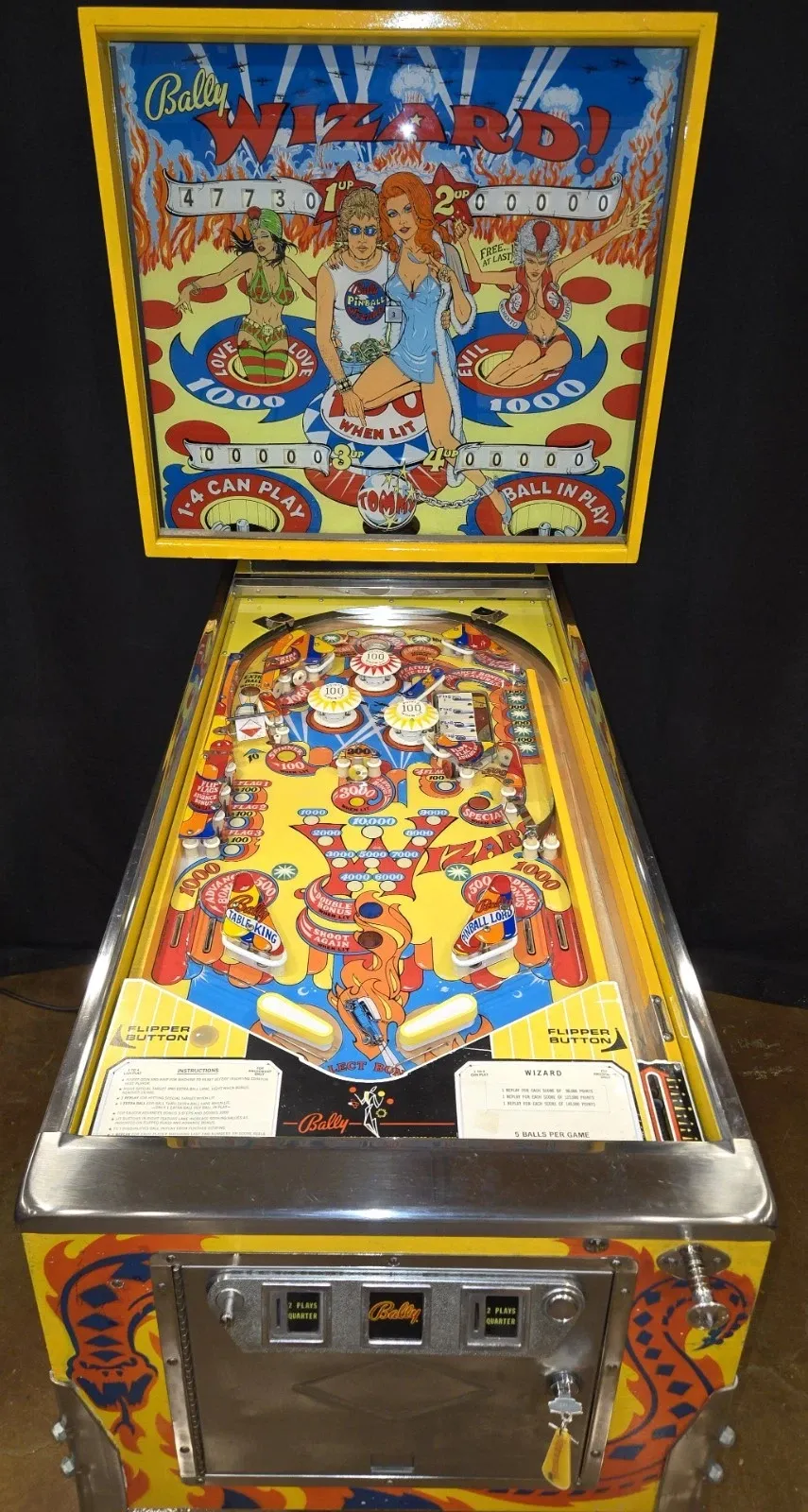
Hailing from Chicago circa 1975, this Bally Manufacturing Corp. creation was a spectacle. Imagine a painted wood cabinet ablaze with vivid psychedelic snake-and-flame graphics, topped by a backglass that practically screamed '70s pop art, riffing unmistakably on the *Tommy*-era pinball mystique. This four-player marvel wasn't shy; it was a bold statement, a mechanical sculpture designed to dazzle and delight, complete with mechanical score reels and gleaming metal trim.
The name, 'Wizard!', was no mere coincidence. It was a direct, audacious wink to The Who's legendary rock opera *Tommy*, which had already enshrined the 'pinball wizard' as a cultural archetype. This wasn't just a game; it was a brilliant piece of cross-promotion, tapping into the very pulse of 1970s youth culture. As the `overall_assessment` notes, it was 'a culturally significant title tied to the wave of interest generated by The Who's rock opera Tommy and the broader pinball revival of the era.' It transformed the game from a simple amusement into a bona fide pop culture icon.
And speaking of cultural icons, the 'Wizard!' also marked a pivotal moment in pinball marketing: the advent of licensed themes. According to Rob Burke, a Guinness World Record holder for the largest pinball machine collection, Tom Nean, Bally's head of marketing, was the visionary behind this. Burke notes that 'Wizard was one of the first license he brought as you see cat and fantastic with Elon John was another one he did very well known and paid very handsomely by balet because he was able to start something had never been done in the pinball industry and that's using licensing to sell the games.' So, yes, the 'Wizard!' shared its groundbreaking licensed lineage with none other than Elton John's 'Captain Fantastic and the Brown Dirt Cowboy' machine. Talk about star power!
But beyond the dazzling art and celebrity connections, the true allure of the 'Wizard!' lay in its electro-mechanical soul. This was the final great generation of EM machines before solid-state electronics took over, and you can still feel the old-school magic. We're talking mechanical score reels, intricate relay banks, buzzing coils, and a dense, hand-routed wiring loom—a veritable mechanical theater of springs, solenoids, and switches. The gameplay was a visceral, tactile experience, a symphony of clicks, clacks, and bells that offered a unique, almost theatrical engagement, a far cry from the silent hum of later digital counterparts.
Yet, even as the 'Wizard!' held court, the late 1970s brought a seismic shift to the arcade landscape. The digital revolution was upon us, and it was swift. Suddenly, pixelated invaders like 'Galaxian' and 'Asteroids' (circa '78-'79) began to steal the spotlight, followed by the absolute sensation of 'Pac-Man' in 1980. Almost overnight, these grand electro-mechanical machines, once the epitome of cutting-edge cool, found themselves relegated to the realm of 'dusty, antiquated throwback amusements,' as the era's rapid technological evolution transformed yesterday's marvels into tomorrow's cherished memories.
For today's discerning collector, a 'Wizard!' machine is a vibrant slice of history, but its value, darling, is all about the details—especially originality. This particular example, while undeniably stunning and 'display-ready,' has undergone a rather comprehensive makeover. The `overall_assessment` points out its 'unusually bright and uniform' playfield, likely a replacement hardtop, along with polished metalwork, refreshed plastics, and modernized lighting. While these interventions boost 'eye appeal and playability,' they do, as the report states, 'reduce originality.' Serious electro-mechanical purists often seek out a more 'intact original survivor,' which can lead to a nuanced valuation. A beautifully restored piece like this might command $2,000-$3,500, but an untouched original could fetch a premium, reflecting the delicate balance between pristine function and historical integrity.
Yet, even after the digital deluge, the Bally 'Wizard!' continues to captivate. It's more than just a game; it's a vibrant artifact, a testament to a bygone era when engineering met artistry, and pop culture found its rhythm in flashing lights and clattering relays. As Rob Burke, the Guinness World Record holder for pinball machines, so perfectly articulates, 'pinball represents a time in my childhood that was a happy time.' And isn't that what Mid-Century Modern collecting is all about? Preserving those moments of pure, unadulterated cool. This 'Wizard!' isn't just a machine; it's a ticket back to a time when the silver ball was king, and every game was a rock-and-roll spectacle.
Mid-Century Modern Marilyn reporting!