
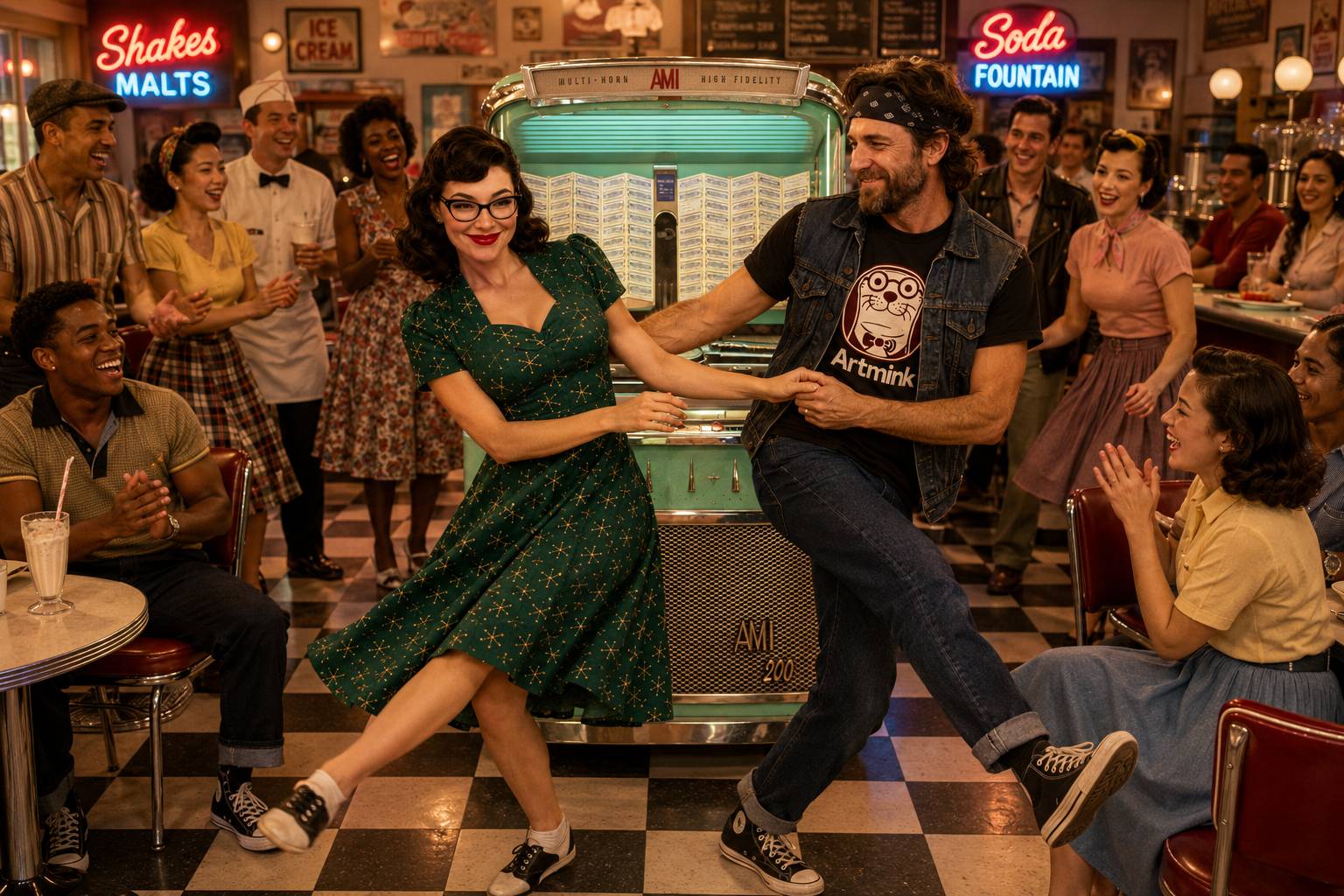
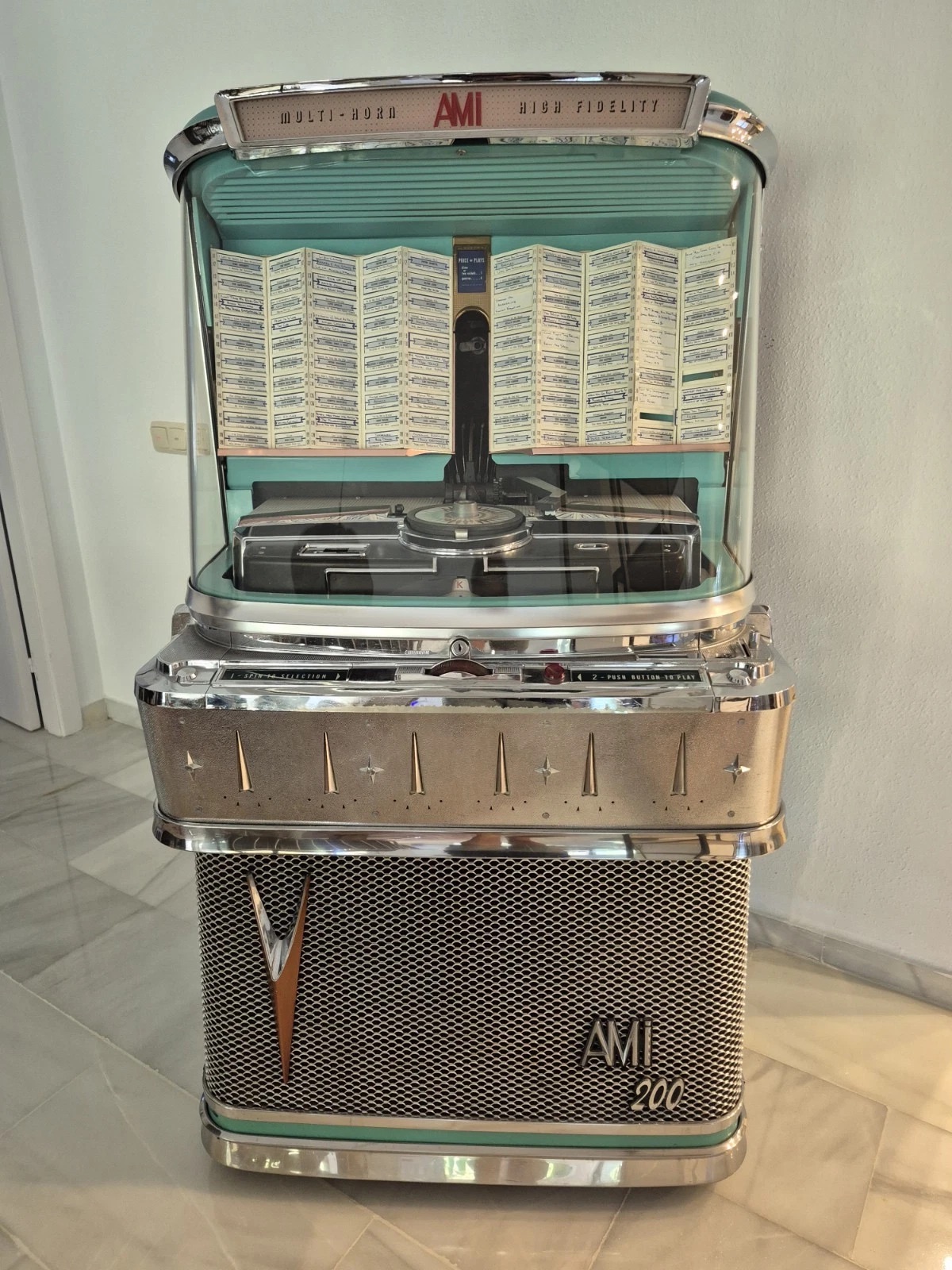
Here we have a fabulous American Mid-Century Modern AMI G-200 jukebox, one of those machines that doesn’t merely play music — it stages it. With its sweeping glass front, vibrant turquoise panels, and gleaming chrome trim, this 1958 marvel captures that late-1950s moment when industrial design flirted shamelessly with the Space Age. It’s a true showstopper, embodying the optimism and futuristic vision of post-war America.
This particular AMI G-200 hails from an era that saw a dramatic shift in jukebox aesthetics. The introduction of the smaller, lighter 45 RPM vinyl record in 1949 allowed manufacturers to move beyond the bulky, wooden “Golden Age” designs of the 1940s. What emerged was the sleek, chrome-heavy, and brightly lit “Silver Age” of the 1950s and 1960s, where jukeboxes could expand their capacities from a mere 20 songs up to a staggering 200 selections. AMI, or Automatic Musical Instruments, Inc., stood proudly among the “Big Four” manufacturers—alongside Seeburg, Rock-Ola, and Wurlitzer—renowned for its wild, automotive-inspired design language.
The G-200 itself is a masterclass in this distinctive style. Its curved glass front offers a tantalizing glimpse of the visible 45 rpm record carousel mechanism, a feature that not only captivated patrons but also symbolized the burgeoning consumer culture. The turquoise and aqua cabinet accents, paired with the polished chrome and perforated speaker grille, are not just decorative; they are deliberate design choices that scream Atomic Age cool. And let's not forget the prominent 'Multi-Horn High Fidelity' marquee, promising a listening experience that, for its time, was nothing short of revolutionary. As one collector noted in a chat, when properly restored, the sound is “wonderfully bold: punchy mids, warm bass, and that classic “jukebox bloom,” more barroom swagger than hi-fi neutrality.”
Authenticating a vintage jukebox like the AMI G-200 involves a keen eye for detail. The visible AMI branding, the 'AMI 200' badge, and that 'Multi-Horn High Fidelity' header are all strong indicators of a genuine period piece. Its commercial-scale construction—a painted steel body, chrome-plated trim, and molded viewing sections—speaks to its original purpose in diners, taverns, and social clubs. This heft and complexity are notoriously difficult to fake convincingly, making the visible mechanism and overall proportions consistent with a true AMI unit from the late 1950s.
Of course, condition is paramount in the collector's market. This particular G-200 presents attractively, with its fresh-looking turquoise finish and bright chrome suggesting a professional restoration or refinishing. This is entirely normal in jukebox collecting; these machines were built to be used and often required cosmetic and mechanical overhauls to keep them spinning. However, the true value often hinges on the originality and functionality of the internal components—the amplifier, coin gear, and intricate wiring—none of which are fully verifiable from exterior views alone.
For collectors, this means a genuine, substantially complete, and operational AMI G-200 in excellent restored condition could fetch an auction estimate of $2,500 to $5,500. If it were a later reproduction or a heavily rebuilt decorative shell, that estimate would drop significantly, closer to $800 to $1,800. The devil, as they say, is in the details, and a thorough inspection of its inner workings is always advised.
The enduring appeal of these machines is perhaps best captured by enthusiasts like Mickey Treat, a vintage coin-op expert who restores these mechanical marvels. As a video transcript quotes him saying, there’s no greater satisfaction than taking a machine “that has not worked in 20 or 30 years, pulling it out of somebody’s barn or basement, fixing it, and bringing it back to life. ‘It’s alive,’ he said. ‘It’s like Frankenstein.’” It’s this passion for preservation and the sheer joy of bringing music back to life that keeps these chrome-plated anthems spinning.
In short: a true rock-and-roll monument, with just enough chrome to make Elvis feel underdressed.
Mid-Century Modern Marilyn reporting!