

"In wartime, truth is so precious that she should always be attended by a bodyguard of lies" is a famous maxim attributed to British Prime Minister Winston Churchill. He reportedly first used the phrase during the Tehran Conference in 1943 when discussing Allied strategic deceptions to hide the true dates and locations of World War II invasions.
In the antiques field, one might paraphrase that: "True antiques are often attended to by a bodyguard of fakes." Allow me to elaborate on this modern day variant of the age-old quest for the under-valued, undiscovered treasure: a.k.a. the sleeper.
The old antique-world fantasy of a hidden masterpiece—the old master oil painting on the flip side of the crying clown, a samurai armor set pulled from a steamer trunk, a Chippendale chest humbled for decades as basement tool storage —has largely faded. For nearly thirty years, the internet has systematically vacuumed material out of attics, estates, and regional auctions at an unprecedented scale. Millions of objects passed through online marketplaces, surfacing generations of dormant material. The raw supply of fresh, undiscovered 'sleepers' is surely down, even as the overall supply of objects has never been higher. An ebay search in 2008 for "18th century" would yield around 3,000 results. As of this writing (May 2026), the same query garners 37,000 hits, mainly fakes.
Yet, the 'sleeper' hasn't vanished; it has merely evolved, or perhaps we could say "mutated" into a different animal, camouflaged and elusive. Today, authentic objects often lie buried in plain sight, obscured by systemic dysfunctions in the market. Three mechanisms, in particular, now produce these 'new sleepers' over and over again, often overlapping and reinforcing each other.
**1. Fake Saturation Taints Entire Categories** Nowhere is this more evident than in the market for African art. For decades, a relentless tide of newly carved 'tribal' objects, artificially aged for decorators and the tourist trade, has flooded the market. Fake Baule statues, ersatz Punu masks, and countless reproductions of Benin bronzes and Yoruba carvings have emerged from workshops dedicated to manufacturing instant ethnographic atmosphere. This saturation creates a psychological shift: once fakes pervade, the entire category becomes untouchable, unless rock solid provenance exists. Collectors grow cautious, dealers hedge, and even auction houses downgrade descriptions to avoid disputes. In time, the whole category gets stiff-armed: go watch a hundred episodes of Antiques Roadshow; you won't see three African pieces come up.
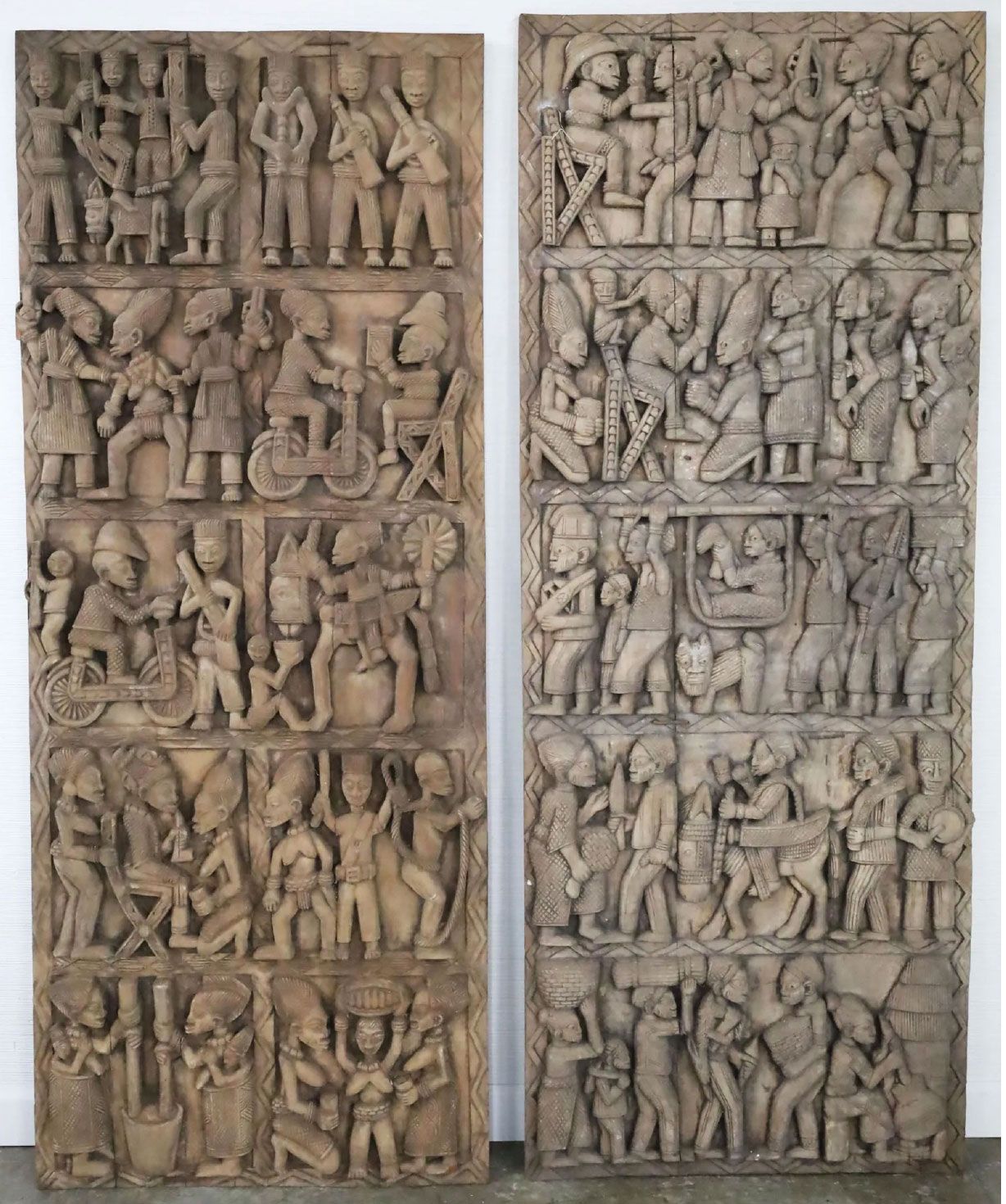
Consider this commanding pair of Yoruba carved hardwood narrative panels (Artmink report id "nkx3ve") . Each is a vertical storyboard in wood, each with five rows (called registers) of figures striding, drumming, riding horses, doing domestic chores, returning from the hunt, paying obeisance to the Oba (king) and even zipping along on scooters.
These door-sized panels, carved in high relief from dense West African hardwood—likely iroko—present a fascinating blend of tradition and modernity. Figures with elongated heads, almond eyes, and incised coiffures engage in royal processions, women pound grain, and drummers perform, all framed by a distinctive zigzag border. Yet, the inclusion of colonial hats, bicycles, and scooters firmly places them in the second quarter of the 20th century, an era of late colonial rule and burgeoning urban life. While they draw directly from traditional Yoruba visual language, they were "likely conceived as architectural doors or wall panels for a modern interior rather than for traditional palace use," reflecting a shift towards decorative or export markets.
They read like a visual chronicle of traditional Yoruba life meeting the modern world, which would track perfectly with the estimated age of circa 1920s-30s, right in the middle of the British Colony and Protectorate of Nigeria period (1900-1960).
**2. Provenance Is Sometimes Deliberately Destroyed** Beyond the shadow of fakery, authentic objects can become 'sleepers' when their provenance is deliberately destroyed. Collectors often imagine provenance simply disappears—lost labels, forgotten paperwork in deceased estates. But it's also erased intentionally. This very pair of Yoruba panels offers a stark illustration. They surfaced at auction, with zero provenance offered, and miscatalogued as "Dogon", A post-sale call to the auction hall yielded only tanatalyzing tidbits: the auction house rep claimed that the panels had been consigned by a university department where they had reportedly resided for decades after having been donated. No more details were forthcoming: no donor name, no institutional file, no departmental history, no publication record, no old in situ photos. Why the tight lips? The consignor wished to remain anonymous. Why is that? We can only speculate, but it is known that Institutional deaccessioning can be awkward. Donors often envision their gifts passing into permanent stewardship in their new "forever home"--not liquidation pipelines. Universities quietly sell objects, but administrators, estates, and donors often prefer anonymity due to tax considerations, internal politics, or reputational caution. The result is profound: the object survives, but its historical threads are cut. In practical market terms, perhaps 90 to 99 percent of its value evaporates overnight, simply due to the loss of a paper trail.
**3. Auction Houses Manufacture Sleepers Via Defensive Under-cataloging** Finally, 'sleepers' are manufactured by auctioneers and "experts" themselves through defensive under-cataloging. Auction houses and dealers increasingly fear attribution risk; one angry buyer can create expensive headaches like clamoring for refunds and posting negative reviews. To protect themselves, institutions often resort to strategic vagueness and underwhelming descriptions. Resetting the date to zero based on a repair, caling a fine wood simply "hardwood", damning a bronze statue by implying that it's one of a pair, the other lost, and on and on. Auction houses throw their consignors under the bus, favoring inventory velocity and volume over properly describing any individual sale even if a piece deserves it. This is the other half of the auction description problem: the fakes being called authentic being, of course, the other side of the coin.
The upshot is, sleepers are still out there--they just aren't being pulled in such volume straight from attics and basements anymore. The bodyguard of lies is still there--but now its cover has been blown.
Reporting for Artmink..!