


Ah, my dear collectors, step into the enchanting, sometimes mischievous, world of Chinese Qing-style furniture! Today, we have a rather handsome specimen to admire: a Chinese Qing Style Carved Hardwood Daybed, or as we say in Mandarin, 中国清式硬木雕花罗汉床 (Zhōngguó qīng shì yìngmù diāohuā luóhàn chuáng). It’s a piece that whispers tales of imperial grandeur, yet, like a charming storyteller, it might just be spinning a yarn about its true age.
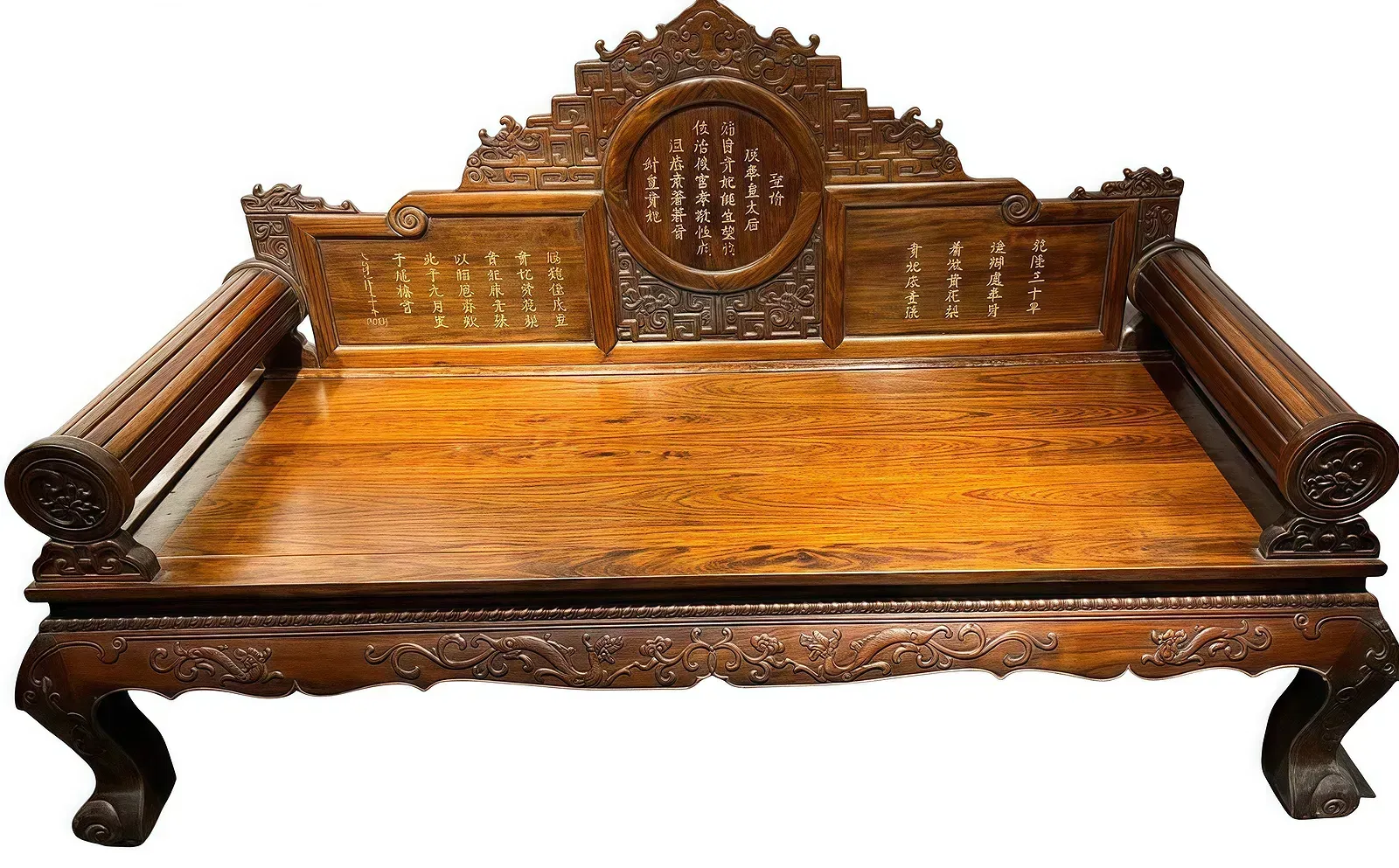
This daybed, with its raised backrest, elegant scrolling, and fretwork crest, certainly captures the eye. It evokes the opulent aesthetic of the Qing dynasty, particularly the era of the Qianlong Emperor (乾隆帝 qiánlóng dì), who reigned from 1736 to 1795. This was a golden age for Chinese arts, with imperial workshops churning out masterpieces in precious zitan and huanghuali woods. These genuine Qianlong-era pieces, my friends, can fetch millions at auction, making them the ultimate prize for collectors—and, alas, the prime target for clever forgers.
Why Qianlong, you ask? Well, the emperor himself was a prolific patron and connoisseur, commissioning an astonishing array of art. His reign became synonymous with peak craftsmanship and imperial splendor. So, when a piece bears a Qianlong mark, it instantly gains an aura of prestige and, of course, a hefty potential price tag. This allure is precisely why counterfeiters love to sprinkle a little 'Qianlong magic dust' on lesser pieces, hoping to transform them into palace-worthy artifacts.
Our featured daybed, for example, comes with inscriptions that boldly declare a connection to the 30th year of Qianlong’s reign—that would be 1765! And if that weren't enough, the inscription even references a concubine. Now, isn't that just a little *too* perfect? As one expert assessment notes, "The complication is in the details." While such inscriptions are meant to impress, they often serve as a red flag. Genuine imperial palace workshop calligraphy is incredibly precise and fluid; stiff, shaky, or overly deep carvings often hint at modern tools and a less-than-authentic hand.
Speaking of dates, it’s useful to know a little secret. Chinese dates on antiques usually appear in one of two ways: either as a reign year (like our daybed's 'Qianlong 30th year') or as two characters from the 60-year cycle of stems and branches. Keep an eye out for the character 年 (nián), which means 'year'—it’s a common sight on both real and fake pieces. But often, the fakes are a bit *too* enthusiastic with their dating, making their claims a little over the top, don't you think?
Beyond the inscriptions, the devil is truly in the details when it comes to authenticity. This daybed, though visually attractive and competently made, has a glossy, uniform finish and carvings that are perhaps a little *too* crisp and regular. A genuine Qing-period piece would have lived a long life, accumulating a deep, softened wear and an uneven patina from decades of human contact and atmospheric exposure. As a curator's answer explains, "A genuine Qing-style daybed typically showcases intricate craftsmanship, including uneven patina, subtle variations in carving depth, and a more complex wood grain due to age." Fake patina, on the other hand, is often too uniform or easily rubs away.
Then there's the construction. High-end Qianlong furniture famously utilized complex, handmade 榫卯 (sǔn mǎo) mortise-and-tenon joinery, without a single nail in sight. Loose joinery or perfectly uniform, machine-cut dovetails are massive red flags. And the wood itself? While our daybed is a handsome hardwood, likely elm or walnut, genuine imperial pieces were primarily crafted from dense, prized woods like zitan (red sandalwood) and huanghuali. Many fakes, sadly, are made of cheaper, stained woods.
So, what's a collector to do? "My appraisal leans toward a modern or late revival piece rather than a genuine Qing-period furnishing," states the expert assessment. This doesn't diminish its beauty, of course! Many modern collectors actually prefer Qing-style reproductions. They offer the aesthetic appeal of intricate designs and vibrant finishes, often better suited to contemporary decors and, crucially, modern budgets. Authentic Qing furniture can be prohibitively expensive and comes with a significant responsibility for preservation. Reproductions allow us to enjoy the grandeur without the financial burden or the constant worry about historical integrity.
Ultimately, whether you're eyeing a genuine antique or a charming revival piece, the journey of collecting Chinese art is one of continuous learning and appreciation. Always consult specialized appraisers who deal heavily in Asian art. They are your best guides through the fascinating, sometimes tricky, landscape of Chinese furniture. For this daybed, it’s a beautiful piece that tells a story—just perhaps not the one etched in its panels.
And that's etched in Jade..!